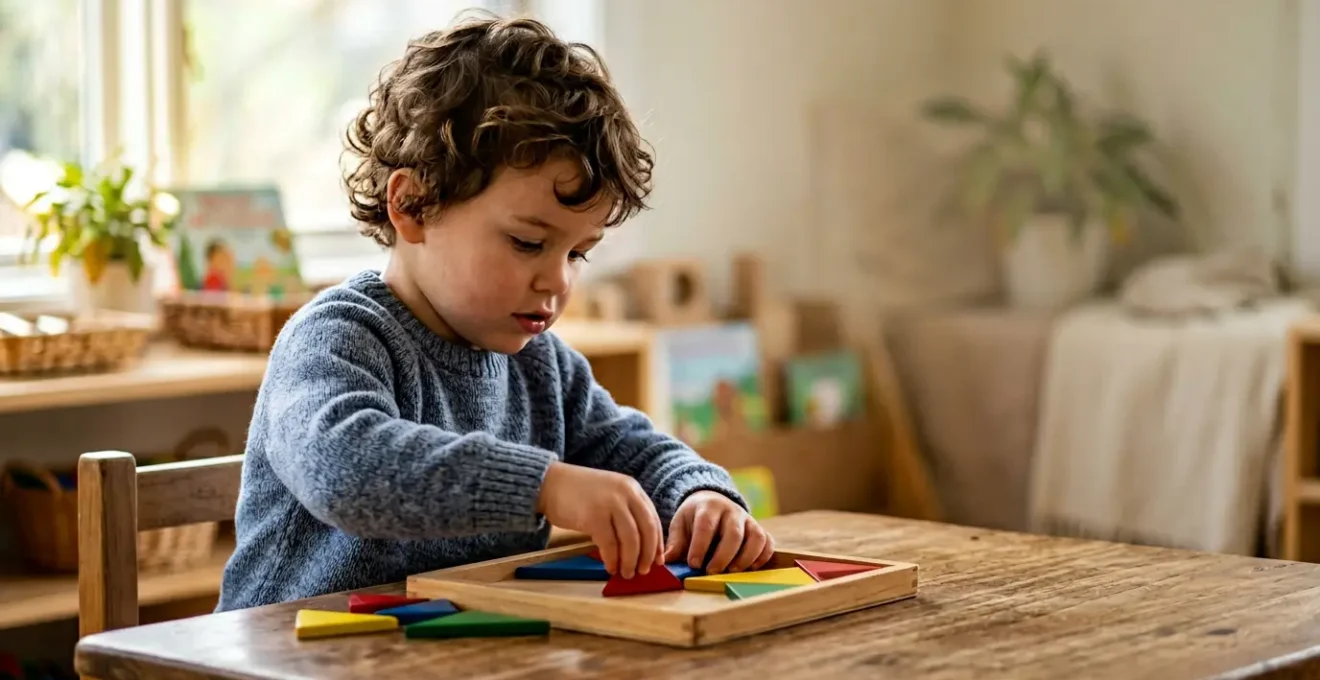
When a preschooler declares a puzzle « too hard » and gives up, the parental instinct is to help them find the piece. This guide offers a more powerful approach: transforming you from a simple helper into a resilience coach. By understanding the cognitive skills behind puzzle-solving and using strategic techniques like scaffolding and process-praise, you can teach your child not just how to complete a puzzle, but how to embrace and overcome any challenge.
You’ve seen it a hundred times. The new, colorful puzzle is spread out on the floor. Your child eagerly fits one or two pieces, then hits a snag. A piece doesn’t fit. They try again, rotating it with growing impatience. Then comes the frustrated sigh, the shove that scatters the pieces, and the dreaded declaration: « It’s too hard! » Your immediate instinct is to jump in, find the right piece, and restore harmony. But in that moment of trying to « fix » the problem, we often miss the real opportunity.
Most parenting advice focuses on the obvious: be patient, offer encouragement, or break the task down. While well-intentioned, this advice overlooks the root of the issue. The challenge isn’t just the puzzle; it’s the child’s developing ability to manage frustration, sustain attention, and deploy problem-solving strategies. The meltdown isn’t a failure, it’s a signal. It’s a sign that their cognitive toolkit for handling difficulty is still under construction.
What if the true key to building persistence wasn’t about finding the right puzzle piece for them, but about intentionally equipping them with the mental tools to find it themselves? This article shifts the perspective from providing answers to building capabilities. We will move beyond generic encouragement and explore how to become a « scaffolding strategist »—a parent who understands the cognitive science of learning and uses every « too hard » moment as a targeted training session for resilience.
We’ll explore why puzzles are a powerful workout for your child’s brain, how to provide help that empowers rather than enables, and the single biggest praise mistake that can accidentally make children fear challenges. This is your guide to turning puzzle time from a source of frustration into a foundation for lifelong persistence.
To navigate this journey from helper to coach, this article is structured to build your strategy step-by-step. Below is a summary of the key areas we will cover to help you master the art of building resilience in your preschooler.
Summary: A Strategic Guide to Building Puzzle Persistence
- Why Solving Riddles Boosts Working Memory and Inhibition?
- How to Help Without Solving the Puzzle for Them?
- Jigsaw or Tangrams: Which Spatial Skill Is More Important?
- The Praise Mistake That Makes Kids Afraid of Difficult Tasks
- When to Upgrade the Puzzle: Signs Your Child Is Ready for More Pieces?
- Why 90% of the Play Should Come From the Child, Not the Toy?
- Why Routines Reduce Anxiety in Children With ADHD?
- Memory Matching Games: How to Improve Your Child’s Attention Span in 10 Minutes a Day?
Why Solving Riddles Boosts Working Memory and Inhibition?
When your child stares at a jumble of puzzle pieces, their brain isn’t just looking for colors and shapes. It’s performing a complex cognitive workout. Two of the most critical skills being trained are working memory and inhibition. Think of working memory as the brain’s « mental sticky note »—it’s the ability to hold and manipulate information for a short period. When solving a puzzle, a child must remember the shape of the empty space while scanning the pile for a matching piece. This is working memory in action.
Inhibition is the brain’s « braking system. » It’s the ability to suppress a dominant or impulsive response to do something more thoughtful. For a preschooler, this means resisting the urge to jam a piece into a spot where it clearly won’t fit. Instead, they must inhibit that impulse, pause, and think of another strategy. These two skills are pillars of what are known as executive functions, the high-level cognitive processes that govern self-control and goal-directed behavior.
The connection isn’t just theoretical. Research on preschool executive functions demonstrates that strong working memory and inhibition are directly linked to better problem-solving abilities. In fact, one study on early childhood development confirmed that by ages 4.5 and 5.3 years, both inhibition and working memory performance were significantly associated with cognitive flexibility—the very skill needed to overcome a « stuck » moment. A Norwegian study focusing on young children even highlighted that early difficulties with these functions can be related to symptoms of ADHD, reinforcing the importance of nurturing them from a young age through playful, engaging activities like puzzles.
So, when you see your child struggling, remember they are not just playing. They are in a cognitive gym, strengthening the mental muscles required for focus, planning, and emotional regulation. The goal isn’t just to finish the puzzle; it’s to complete the reps for their brain.
How to Help Without Solving the Puzzle for Them?
The moment your child says, « I can’t do it, » your instinct is to solve the problem for them. But intervening too directly robs them of the learning opportunity. The most effective way to help is to become a « scaffolding strategist. » The concept of scaffolding in education refers to providing temporary, supportive structures that help a learner accomplish a task they couldn’t do alone. Once the skill is learned, the scaffold is removed.
Instead of pointing to the correct piece (solving the puzzle), you provide prompts that guide their thinking process. This is the difference between giving a fish and teaching how to fish. Your role is not to be the answer key, but the guide who helps them develop their own problem-solving strategies. This technique is about being present and supportive without taking over, creating a space for them to make their own connections.
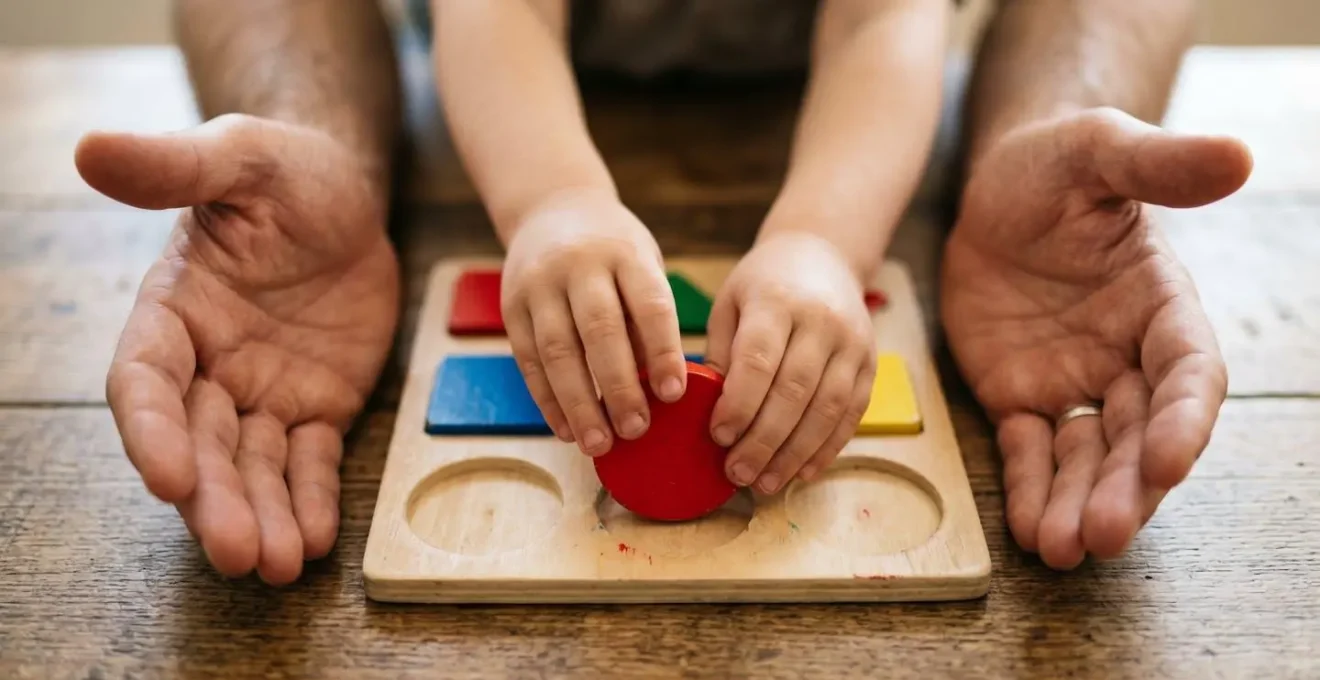
As the image above illustrates, scaffolding is about creating a supportive presence, not an interfering one. Your hands are nearby, ready to offer a nudge in the right direction, but the child’s hands are the ones doing the work. You can do this with language by asking metacognitive prompts—questions that encourage them to think about their own thinking. Try questions like:
- « What did you try already? »
- « What do you notice about the shape of that empty space? »
- « Are there any pieces with a similar color to this spot? »
- « What could you try next? »
This approach shifts the focus from the answer (the piece) to the process (the strategy). It communicates that you have faith in their ability to figure it out, and your job is simply to help them unlock the strategy that’s already within them.
Jigsaw or Tangrams: Which Spatial Skill Is More Important?
Parents often wonder about the « best » type of puzzle for their child. Should they focus on traditional jigsaws, or more abstract challenges like tangrams or block puzzles? While different puzzles emphasize slightly different skills—jigsaws focus on part-to-whole relationships and tangrams on mental rotation and transformation—fixating on the « right » type misses the bigger picture. The most important factor isn’t the specific puzzle, but the quality and frequency of engagement with spatial challenges.
Spatial reasoning is not a single skill but a collection of them, including the ability to visualize objects from different angles, understand how they fit together, and navigate the world. Both jigsaws and tangrams are excellent tools for building this mental toolkit. Jigsaws teach a child to look for clues in color, pattern, and edge shape. Tangrams, where a child must create a specific shape from a set of standard pieces, push them to see how a shape can be deconstructed and reconstructed. The key is providing a variety of these experiences.
Rather than asking which puzzle is better, a more strategic question is: « Is my child getting regular opportunities to think spatially? » The evidence strongly supports this focus on consistency. For example, a nationally representative U.S. study of 847 children ages 4-7 found that children who engaged with puzzles and similar toys more than six times a week had significantly higher spatial reasoning scores. The benefit comes from the consistent practice, not from a single « perfect » toy.
The takeaway for parents is to stop worrying about having the ideal puzzle and instead focus on creating a home environment rich with diverse spatial toys. Blocks, jigsaws, tangrams, and even drawing and navigating a playground all contribute to a robust foundation in spatial awareness. The goal is to make spatial thinking a regular part of play, not a one-off activity.
The Praise Mistake That Makes Kids Afraid of Difficult Tasks
When your child finally clicks that last puzzle piece into place, your first instinct is to exclaim, « You’re so smart! » It feels natural and encouraging, but it’s one of the most common and counterproductive mistakes a parent can make. This type of feedback, known as ability praise, can inadvertently teach children to fear challenges and crumble at the first sign of difficulty.
The groundbreaking research of Stanford psychologist Carol S. Dweck provides clear evidence for this. Her work on « growth mindset » versus « fixed mindset » reveals that when we praise children for an innate quality like intelligence, we send the message that success is based on a fixed trait they either have or don’t. This creates anxiety. If they succeed, they feel pressure to live up to the « smart » label. If they struggle, they conclude they must not be smart after all, leading them to give up or avoid difficult tasks in the future to protect their ego.
As Dweck’s research powerfully states:
Praising kids’ intelligence backfires. Rather than building their confidence, it puts them into a fixed mindset and makes them vulnerable.
– Carol S. Dweck, Parents League of New York
The alternative is process praise. This means focusing your feedback on the effort, strategies, focus, and persistence the child demonstrated. Instead of « You’re so smart, » try:
- « I saw how you kept trying even when it was tricky. That’s great persistence! »
- « That was a clever strategy to sort all the edge pieces first. »
- « You focused so hard on finding that piece. Well done! »
This small shift in language makes a world of difference. Process praise teaches children that success comes from effort and strategy, things that are within their control. According to Dweck, studies with children as young as four show that those praised for their process are far more likely to embrace challenges and persevere through setbacks. They learn that struggling is a normal and productive part of learning, not a sign of failure.
When to Upgrade the Puzzle: Signs Your Child Is Ready for More Pieces?
Choosing a puzzle that’s too easy leads to boredom, while one that’s too hard guarantees frustration. The goal is to find the « sweet spot » of challenge—a task that is difficult enough to require effort and strategy but not so overwhelming that it causes a meltdown. As a resilience coach, your job is to observe your child and know when it’s time to increase the complexity. Age is a guideline, but readiness and engagement are the true indicators.
So, how do you know when to upgrade from a 12-piece to a 24-piece puzzle? Look for clear signs of mastery and confidence. Your child might be ready for a bigger challenge if they exhibit these behaviors:
- Speed and Efficiency: They complete their current puzzles quickly and with little to no help. They seem to be working from memory rather than actively problem-solving.
- Independent Completion: They can consistently finish the puzzle entirely on their own, from sorting to placing the final piece.
- Verbal Confidence: They might say things like, « This is an easy one! » or show a lack of deep engagement. This is a sign the cognitive workout is no longer challenging enough.
Conversely, if you’ve moved up too quickly, you’ll see signs of genuine frustration. This isn’t just a moment of being stuck; it’s a consistent pattern of giving up early, scattering pieces, or avoiding the puzzle altogether. This is a signal to step back to a more comfortable level to rebuild confidence before trying the harder puzzle again.
The progression should be gradual. Don’t jump from 12 to 50 pieces. A structured approach allows you to build on success. A good rule of thumb is to start with 4-6 piece puzzles for very young learners, move to 12 pieces once those are mastered, and then advance to 24 pieces. The key is to always individualize the experience based on your child’s unique pace and emotional state, rather than following a rigid timeline.
Why 90% of the Play Should Come From the Child, Not the Toy?
In a world of flashing lights and talking toys, it’s easy to think a « smarter » toy is a better one. But when it comes to building persistence and cognitive skills, the opposite is often true. The most powerful learning tools are « dumb » toys—those that are simple and open-ended. The guiding principle is this: the toy should be 10% of the equation, and the child’s brain should be the other 90%. This is the play-to-skill ratio in action.
An electronic puzzle that cheers when a piece is placed correctly or lights up the next spot reduces the child’s cognitive load. The toy does the thinking, providing immediate feedback and direction. While this can feel rewarding, it short-circuits the very processes we want to develop: internal problem-solving, frustration tolerance, and self-correction. An open-ended wooden puzzle, on the other hand, provides no such clues. The child must supply all the cognitive effort: sorting, rotating, testing hypotheses, and evaluating success. This is where deep learning occurs.
This principle is vividly illustrated by observing children in natural play settings. In one case study, educators watched a child’s deep engagement with a simple, open-ended puzzle.
Case Study: The Power of Child-Driven Play
Educators observed a 3-year-old named Saaliha working independently on a simple rainbow puzzle. Without any adult intervention, she demonstrated incredible persistence. She first tried to fit pieces randomly, then shifted her strategy to sorting them by size. She turned them, moved them, and tested different arrangements until she succeeded. This observation highlighted how an open-ended puzzle, where the child does all the cognitive work, naturally fosters concentration, spatial awareness, and intrinsic motivation. The satisfaction came from her own effort, not from external praise or a toy’s programmed response.
This is why simple blocks, plain puzzle pieces, and art supplies are timeless educational toys. They are platforms for imagination and problem-solving, not scripts to be followed. When you choose a toy, ask yourself: « Who is doing the work here, the child or the toy? » For building resilience, always choose the toy that makes your child’s brain work harder.
Key Takeaways
- Persistence is a skill built through strategy, not just encouragement. Your role is to be a coach, not just a helper.
- Effective praise focuses on the process (effort, strategy) rather than innate ability (« You’re so smart »), which builds a growth mindset.
- The best learning happens with simple, open-ended toys where the child does the cognitive work, not electronic toys that provide all the answers.
Why Routines Reduce Anxiety in Children With ADHD?
For any child facing a frustrating task, predictability is a powerful antidote to anxiety. This is especially true for children who may have challenges with executive functions, such as those with ADHD. When a task feels big and undefined, it can be overwhelming, leading to a « fight or flight » response where the child simply shuts down or melts down. A predictable routine acts as an anchor, reducing the cognitive load required to simply start the task.
Think of it this way: when a child doesn’t know where to begin, their brain has to work overtime just to figure out the first step. This uses up precious mental energy that could otherwise be spent on solving the actual puzzle. A routine outsources that initial decision-making. By creating a consistent, step-by-step framework for tackling a puzzle, you create a sense of safety and predictability. The child knows what’s coming next, which frees up their working memory and attention to focus on the challenge at hand.
This structure doesn’t just reduce anxiety; it also models a critical life skill: how to break a large, intimidating project into small, manageable steps. This is a foundational strategy for everything from homework assignments to complex professional projects later in life. By practicing this with puzzles, you are laying the neural groundwork for future success.
The routine itself can be simple, but the consistency is what gives it power. It transforms an unpredictable challenge into a familiar game with clear rules, making your child more willing to engage in the first place.
Your Action Plan: The 5-Step Puzzle Routine to Reduce Anxiety
- Unbox & Observe: Before starting, take a moment to look at the picture on the box together. Talk about the colors and objects you see to prime their brain.
- Sort the Borders: Make it a rule to always find all the edge pieces with straight sides first. This provides an immediate, achievable goal.
- Group the Colors: Once the border is done, sort the remaining pieces into piles by color or pattern. This breaks the big mess into smaller, less intimidating groups.
- Take a ‘Brain Break’: Normalize pausing. If you see frustration building, say, « This is a tricky part! Let’s take a brain break for a minute and come back. » This validates their feelings and teaches self-regulation.
- Celebrate the Process: When the puzzle is done (or even when a tough section is completed), use process praise. Acknowledge the strategies they used (« Sorting the colors was a great idea! ») rather than just the completion.
Memory Matching Games: How to Improve Your Child’s Attention Span in 10 Minutes a Day?
While logic puzzles are fantastic for problem-solving, another simple game is a powerhouse for building a different but related skill: sustained attention. Memory matching games, where a child has to find pairs of cards, are a direct and effective workout for focus and working memory. For a child who gives up easily, attention span is often a key part of the challenge. Their mental energy for focusing on one task is limited, and once it’s depleted, frustration sets in.
Memory matching games work by requiring a child to do two things at once: hold information in their working memory (remembering that the cat card was in the top left corner) while focusing their attention on the current turn. Each flip of a card is a small test of concentration. Was this the spot where they saw the matching card before? This constant cycle of encoding, remembering, and retrieving strengthens the neural pathways for attention.
The beauty of this game is its scalability. You can perfectly tailor the difficulty to your child’s current ability, ensuring they stay in that sweet spot of challenge without becoming overwhelmed. Starting with just three or four pairs allows for quick successes, building confidence and making the « game » feel fun, not like work. As their ability grows, you can gradually add more pairs, progressively increasing the demand on their attention and memory.
Just like with physical exercise, short, consistent sessions are more effective than infrequent, long ones. A dedicated 10-minute session with a memory game each day can have a significant impact on your child’s ability to focus on other tasks, including more complex puzzles. It’s a targeted training drill that builds the foundational attention stamina needed to persevere when things get tough. The principles you’ve learned—using process praise and keeping it fun—apply just as much here as they do with jigsaws.
By shifting your role from a quick-fix helper to a strategic resilience coach, you do more than help your child finish a puzzle. You equip them with a growth mindset, a toolkit of problem-solving strategies, and the confidence to face any challenge—on the puzzle board and in life—with the powerful belief that « I can figure this out. »