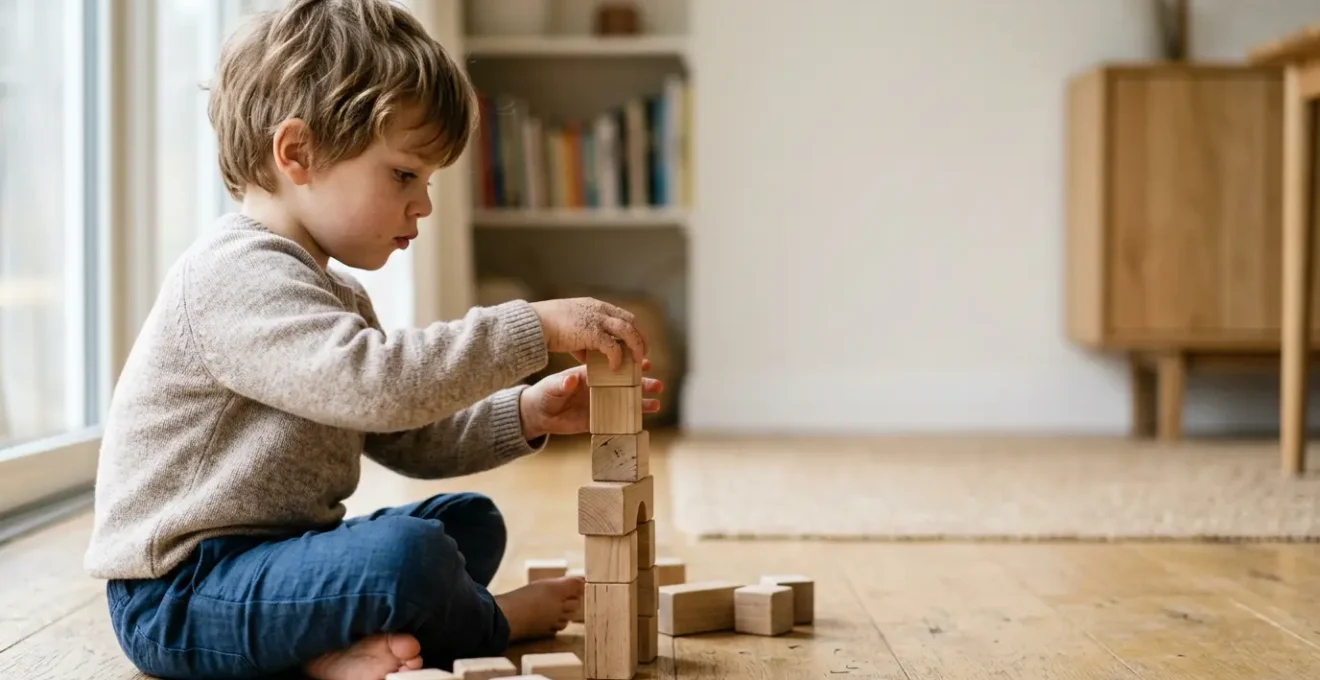
The most « educational » toy is not one that teaches, but one that invites the child to become the teacher.
- Fewer, simpler toys lead to deeper, more imaginative play by reducing cognitive load.
- The prepared environment—how toys are displayed and rotated—is more critical than the toys themselves.
- True development comes from fostering a child’s intrinsic motivation to explore, not from a toy’s electronic prompts.
Recommendation: Shift your focus from buying more toys to intentionally curating your child’s play environment to empower their natural curiosity.
The scene is familiar to many parents: a room overflowing with colorful, noisy, battery-operated toys, each promising to make your child smarter, faster. Yet, the child is often more interested in the cardboard box the toy came in. This frustration leads to a cycle of searching for the next « perfect » educational toy, believing the right purchase will finally unlock focused, creative play. We are conditioned to think that a toy’s value is in its features—the lights, the sounds, the pre-programmed activities.
But what if this entire approach is fundamentally flawed? The constant search for novelty and stimulation often overlooks the most powerful engine of development: the child’s own mind. The principles of Montessori education and modern neuroscience suggest a counter-intuitive truth. The true « work » of childhood—play—thrives not on complexity and external direction, but on simplicity and internal motivation. The problem isn’t a lack of the right toys, but an environment that overwhelms a child’s ability to engage deeply.
This article re-frames the conversation. Instead of providing a shopping list, it offers a philosophy. We will explore why the power of play must come from the child, not the toy, and how to create a prepared environment that fosters this. We will move beyond the what (which toys to buy) and into the why and how: how to curate, display, and even gamify a child’s world to nurture the concentration, creativity, and executive function that passive, electronic toys simply cannot.
This guide will explore the practical strategies for transforming your child’s play. We’ll delve into the science of attention, the art of toy rotation, and the surprising developmental benefits of simple staples, providing a clear path to a more intentional and fulfilling play experience for both you and your child.
Summary: A Guide to Intentional Play and Creativity
- Why 90% of the Play Should Come From the Child, Not the Toy?
- How to Rotate Toys to Renew Interest Without Buying Anything New?
- Blocks or Dolls: Which Staple Toy Offers More Developmental Benefits?
- The « Too Many Options » Mistake That Reduces Attention Span
- How to Display Toys on Low Shelves to Encourage Autonomous Choice?
- How to Organize a Gear Swap to Save Money Within Your Community?
- How to « Gamify » Chores so Kids Want to Participate?
- DIY Sensory Play: How to Create Safe Texture Bins for Babies Under 1 Year?
Why 90% of the Play Should Come From the Child, Not the Toy?
The fundamental difference between an open-ended toy and a battery-operated one lies in a simple question: who is doing the work? A toy that lights up and sings a song when a button is pushed dictates the terms of play. The child’s role is reduced to a simple cause-and-effect action—push button, receive stimulus. The toy is the performer; the child is the audience. This passive entertainment is the opposite of developmental « work. » With an open-ended toy, such as a set of plain wooden blocks, the toy does nothing on its own. It is an inert tool. All the creativity, narrative, and action must originate from the child’s mind. The blocks can be a castle, a car, a fence for animals, or abstract patterns. The child is the director, creator, and problem-solver, engaging their imagination and executive functions.
This distinction is critical during the first five years of life. Neuroscience research shows that 90% of brain development is complete by age 5. This period is when foundational neural pathways for creativity, critical thinking, and social skills are being forged. Child-led play is the primary mechanism for building this architecture. When the toy does most of the « thinking, » it short-circuits this crucial developmental process. The child learns to be entertained rather than to create their own engagement.
Case Study: The Power of Simplicity
A decade-long study from Eastern Connecticut State University’s Center for Early Childhood Education underscores this point. Researchers found that children who played with simple, open-ended toys were significantly more likely to engage in creative play, problem-solving, peer interaction, and advanced language development compared to those playing with electronic or predetermined toys. The simpler the toy, the more complex and rich the child’s play became.
The goal is to provide tools, not entertainment. A truly « educational » toy is one that asks questions of the child rather than providing them with pre-packaged answers. It should be 10% toy and 90% child, serving as a blank canvas for the rich, complex, and vital work of play.
How to Rotate Toys to Renew Interest Without Buying Anything New?
The paradox of an overabundance of toys is that it often leads to less play, not more. When a child is surrounded by dozens of options, they experience a form of decision fatigue, flitting from one object to the next without ever engaging deeply. Toy rotation is a simple yet profound Montessori-inspired strategy to counteract this. It involves displaying a small, curated selection of toys for a period and storing the rest out of sight. This limited choice invites focus, mastery, and creativity. When a stored toy is reintroduced, it is often met with the same enthusiasm as a brand-new purchase.
This isn’t just theory; it’s backed by research. For instance, a 2018 study from the University of Toledo found that toddlers offered just four toys at a time engaged more meaningfully with each one. They played in a deeper, more complex way and spent more time exploring the possibilities of each toy compared to toddlers who had 16 toys available. By reducing the clutter, we increase the quality of play.
This paragraph introduces the concept of a structured toy rotation system. To understand how to implement this, it is useful to visualize the ideal setup. The illustration below shows a clean, organized shelf that encourages autonomy.
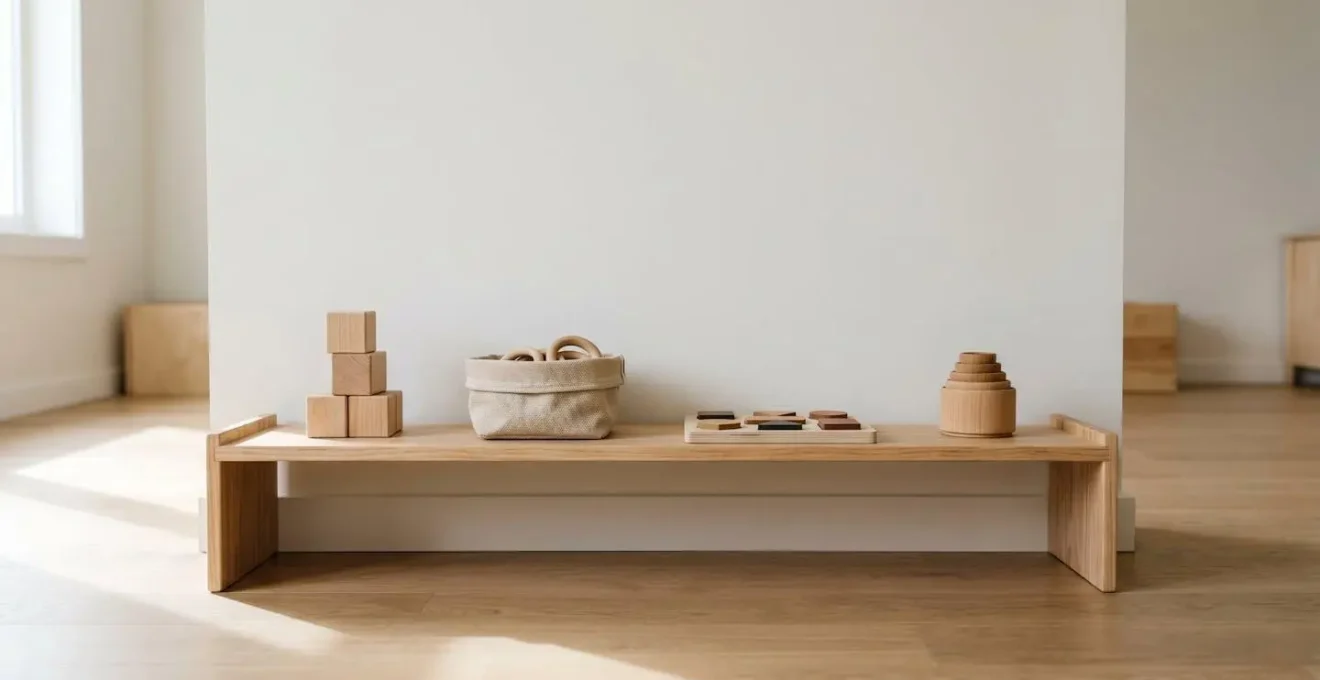
As the image demonstrates, the key is order and accessibility. This « prepared environment » communicates respect for the child and their work. To implement a successful rotation, follow a simple framework:
- Inventory: Keep complete sets in baskets or bags, stored in labeled bins. This makes swapping items quick and organized.
- Cadence: The timing of rotation depends on age and engagement. For babies (3-12 months), a daily swap might be appropriate. For toddlers (1-3 years), rotating one or two items every week or two often works well. Observe the child; if they are deeply engaged with a toy, leave it. If they are ignoring most items, it’s time for a refresh.
- Display: Use a low, open shelf with a designated spot for each of the 4-6 chosen toys. This visual clarity helps the child understand where things belong, fostering a sense of order and responsibility.
By rotating toys, you are not just saving money and reducing clutter. You are curating your child’s environment to teach focus, respect for their belongings, and the joy of rediscovery. You are helping them see the endless potential in the few things they have, rather than constantly seeking novelty in the next new thing.
Blocks or Dolls: Which Staple Toy Offers More Developmental Benefits?
When curating a minimalist toy shelf, parents often face a choice between classic archetypes: constructive toys like blocks versus imaginative toys like dolls or figures. The question of which offers more benefits is a false dichotomy. They are not in competition; they are complementary tools that develop different, yet equally vital, parts of the brain. The true answer is that a well-rounded play diet includes both.
Block play is universally recognized for its connection to STEM skills. As children stack, balance, and build, they are conducting intuitive physics experiments. They learn about gravity, stability, and spatial relationships. This hands-on experience builds a concrete foundation for abstract mathematical concepts. Indeed, research demonstrates that dolls promote language skills while blocks increase mathematical knowledge, establishing their distinct developmental pathways. Building with blocks requires planning, sequencing, and problem-solving—key components of executive function.
Doll play, on the other hand, is a powerful engine for social and emotional development. A groundbreaking study by neuroscientists at Cardiff University provided a fascinating window into this process. Using fNIRS technology to scan children’s brains during play, researchers found that playing with dolls activated the posterior superior temporal sulcus (pSTS), a brain region directly associated with processing social cues and developing empathy. Remarkably, this brain region was active even when children played with dolls alone, suggesting that this type of pretend play gives them a unique opportunity to rehearse social interactions, understand others’ perspectives, and navigate emotional scenarios in a safe environment. This brain activation did not occur when children played a similar game on a tablet.
Therefore, the choice is not « blocks or dolls. » The strategic choice is to offer both. Blocks provide the language of space, logic, and physics. Dolls provide the language of emotion, narrative, and human connection. Together, they equip a child with a robust and versatile toolkit for understanding both the physical and the social world. A small collection of simple blocks and one or two neutral dolls or animal figures can provide a richer landscape for development than a room full of single-purpose gadgets.
The « Too Many Options » Mistake That Reduces Attention Span
The belief that « more is better » is perhaps the most common mistake in modern parenting when it comes to toys. An environment saturated with choices does not create a more stimulated child; it creates an overstimulated and overwhelmed one. This phenomenon, known as the « paradox of choice, » suggests that while having some options is good, having too many leads to decision paralysis and decreased satisfaction. For a toddler, a room full of 90 different toys—a number researchers found was average in one study—is not a wonderland of opportunity. It is a source of cognitive overload.
This concept is visually represented in the chaotic scene below, where an excess of toys creates visual noise and makes deep engagement nearly impossible.
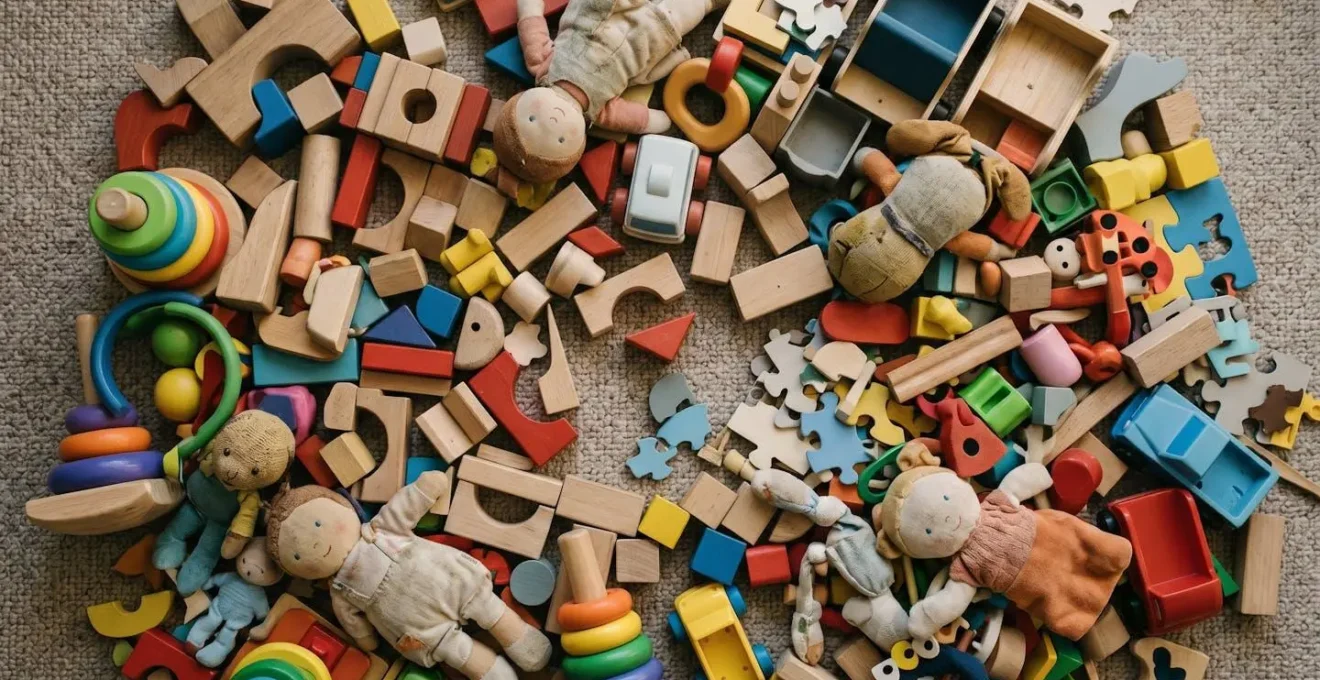
When faced with this level of clutter, a child’s brain struggles to filter out the noise and focus. Instead of selecting one toy and exploring its full potential, they are more likely to drift from one to the next, touching an item for a moment before their attention is pulled away by something else. This pattern actively shortens their attention span and works against the development of deep focus, a critical skill for learning.
A revealing study published in *Infant Behavior and Development* quantified this effect. Researchers observed toddlers in free-play sessions with either four toys or sixteen toys. The results were clear: the quality of play was significantly higher in the four-toy condition. As the study highlights, children with fewer toys played with them for longer periods and in more varied and creative ways. They were less distracted, more inventive, and demonstrated a greater capacity for sustained play. By limiting the options, the adults had inadvertently given the children the gift of focus.
Reducing the number of available toys is one of the most impactful and immediate changes a parent can make to improve their child’s ability to concentrate. It’s not about deprivation; it’s about creating the mental space necessary for creativity and mastery to flourish. In a world of constant stimulation, a calm and uncluttered play space becomes a sanctuary for a developing mind.
How to Display Toys on Low Shelves to Encourage Autonomous Choice?
Play is the work of the child.
– Maria Montessori
This famous statement from Maria Montessori is the philosophical foundation for designing a child’s play space. If play is their work, then their environment should be their office—organized, accessible, and respectful of their ability to be productive. Displaying toys on low, open shelves is not merely an aesthetic choice; it is a functional one that empowers children, fosters independence, and communicates trust. Unlike a toy chest where items are jumbled and hidden, an organized shelf makes toys visible and accessible, inviting the child to make a conscious choice.
Setting up a shelf in this way is about creating a « prepared environment. » The goal is to arrange materials so a child can successfully complete a full « work cycle »: selecting an activity, engaging with it, and returning it to its designated spot without needing adult assistance. This simple process builds a profound sense of competence, responsibility, and order. When a child can see all their options clearly and knows that every item has a « home, » tidying up becomes a logical part of the play process, not a dreaded chore.
The key is to make the setup intuitive from the child’s perspective. The shelves themselves should be at their eye level, sending a clear message: « This space belongs to you. I trust you to manage it. » Each toy or activity should have its own designated spot with ample space around it, which visually communicates its value and makes it easy to put away correctly. You can even create specific « play invitations » by artfully arranging a few complementary items on a small tray—for example, a few shells, a magnifying glass, and a blank piece of paper—to spark curiosity and suggest a new way to explore.
Action Plan: Setting Up a Montessori-Style Shelf
- Designate the Space: Choose a low, stable shelf. Assign one specific spot on the shelf for each toy or activity. Avoid dumping items into a large bin.
- Ensure Accessibility: Position the shelf at the child’s eye level (typically under 36 inches for a toddler). This signals that the materials are theirs to access and manage.
- Enable the Work Cycle: Arrange materials so a child can take, use, and return them independently. Baskets or trays are excellent for containing all the pieces of a single activity.
- Maintain Order and Respect: Ensure every item has a visible « home » with space around it. This visual clarity makes cleanup logical and achievable for a young child.
- Create Play Invitations: Group 2-3 complementary items on a tray to inspire curiosity and suggest an activity, such as playdough with a small rolling pin and a cookie cutter.
By thoughtfully displaying a few select toys, you transform a simple shelf into a powerful tool for teaching independence, focus, and respect for one’s environment.
How to Organize a Gear Swap to Save Money Within Your Community?
Children grow, and their needs change with astonishing speed. The perfectly fitting jacket from last winter is now too small, and the beloved toy of last month now sits untouched. A community gear swap is a brilliant, sustainable, and budget-friendly solution to this constant cycle of outgrowing and replacing. It’s a way for parents to pass on items their children no longer need and acquire « new » ones for free, all while building a stronger community bond. Organizing a successful swap requires a bit of planning but is well worth the effort.
The first step is to gather a small, committed group of organizers. This could be a few friends, neighbors, or parents from a local school or playgroup. With a core team, you can divide tasks and build momentum. The next crucial step is to establish clear rules for participation. This ensures fairness and quality. Common guidelines include:
- Item Condition: All items (clothing, toys, gear) must be clean, in good working condition, and free of stains or damage.
- Item Categories: Decide what to include. Will it be just clothing, or will you also accept books, toys, and larger gear like strollers or high chairs? Be specific.
- Swap Format: Choose how the exchange will work. A one-for-one ticket system (bring five items, get five tickets to « spend ») is common and fair. Alternatively, you could have a free-for-all « market » style, though this can be less equitable if some people bring more than they take.
Once the rules are set, pick a date and a location. A community hall, a school gym, or even a spacious backyard can work well. Give participants plenty of notice—at least three to four weeks—to sort through their items. Promote the event within your target community through social media groups, local flyers, or word of mouth. On the day of the event, have clear areas for different categories (e.g., « Boys’ Clothing 2T, » « Board Books, » « Puzzles ») to make browsing easy.
A gear swap does more than save money and reduce waste; it creates connections. It’s an opportunity for parents to share advice, build friendships, and strengthen the village it takes to raise a child. It is a practical embodiment of the « less is more » philosophy, focused on resourceful sharing rather than perpetual consumption.
Key Takeaways
- The child, not the toy, should be the source of play; provide tools that invite creativity rather than dictating it.
- A curated, minimalist environment with fewer, well-chosen toys reduces cognitive load and dramatically increases a child’s focus and depth of play.
- Life skills, such as tidying and household chores, can be developed through the same principles of intrinsic motivation and playfulness as open-ended play.
How to « Gamify » Chores so Kids Want to Participate?
The same principles that make open-ended play so engaging—autonomy, mastery, and purpose—can be applied to transform mundane chores into enjoyable « games. » The goal of gamifying chores is not to use external rewards like sticker charts or prizes, which can undermine long-term intrinsic motivation. Instead, it is to tap into a child’s natural desire to be helpful, competent, and part of the family team. By reframing a task, you can shift the focus from the drudgery of the chore to the fun of the process.
A powerful first step is to explicitly connect play skills to life skills. When you see your child carefully building a tall block tower, you can say, « You are so good at sequencing those blocks to make them stable! That’s the same skill we use to set the table: fork, then plate, then cup. » This helps them see chores not as arbitrary rules, but as an extension of the competencies they are already mastering through play.
The right framework can turn any chore into a mission. A « Beat the Clock » game, for example, uses a timer to create a low-stakes sense of urgency for tasks like tidying up. The challenge is collaborative: « Can *we* put all the blocks away before the song ends? » Another approach is the « Mission » framework, which uses narrative to create engagement. Tidying a room becomes a « Treasure Hunt » for out-of-place items, and sorting laundry becomes a « Color Agent Mission » to separate the darks from the lights. The goal is the successful completion of the mission, and the reward is the feeling of accomplishment and having contributed to the family.
This is where a child’s developing fine motor skills and focus, honed through activities like sorting, can be put to practical use, as shown in the image below.
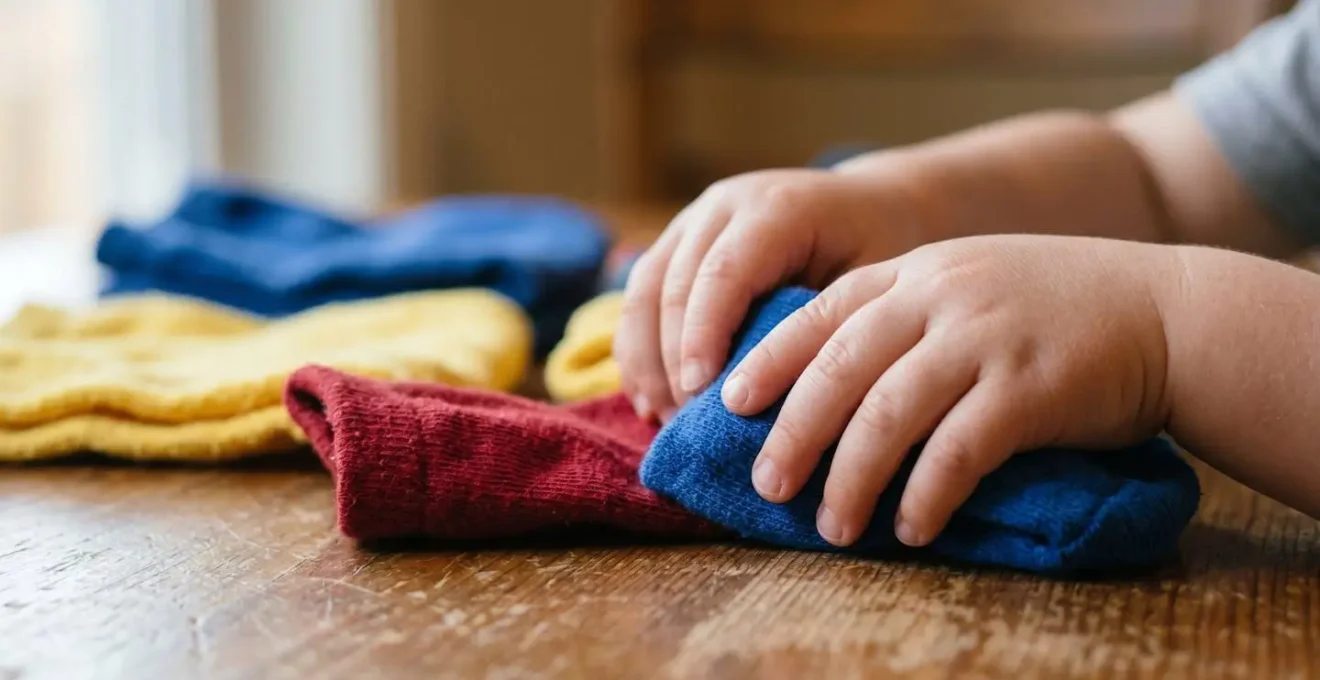
By framing chores as collaborative challenges, you leverage the social skills developed during play. The « win » is not a sticker, but the shared success of a job well done. This approach fosters a sense of belonging and responsibility, teaching children that their contribution is valuable to the family unit. It transforms them from passive observers into active, capable participants in the household, all through the power of play.
DIY Sensory Play: How to Create Safe Texture Bins for Babies Under 1 Year?
Long before a child can build a tower or tell a story, their primary mode of learning is through their senses. Sensory play is not just for fun; it is a critical neurological process. During the first few years, at least 1 million new neural connections are formed every second, and sensory experiences are the raw material for this brain construction. For babies under one, who explore the world with their hands and mouths, it is essential that this exploration is safe. Taste-safe sensory bins are a perfect solution, providing rich tactile experiences without the worry.
Creating a taste-safe bin is simple and inexpensive. The goal is to provide a variety of textures that are safe if ingested in small amounts during supervised play. You can use a shallow bin or, for babies who are not yet sitting independently, a large rimmed baking sheet for supervised tummy time. This « sensory sheet » method contains the mess while allowing non-mobile infants to participate fully.
The possibilities for taste-safe fillers are endless and can be found right in your kitchen. Consider organizing them by texture to provide varied experiences over time:
- Mushy Textures: Plain unsweetened yogurt, mashed bananas, or cooled pumpkin puree are excellent for babies 8 months and older. This messy play is fantastic for desensitizing them to different food textures, which can help prevent picky eating later.
- Grainy Textures: Finely ground oats, cornmeal, or cooked and cooled rice or pasta shapes offer a different tactile feel. This encourages the development of fine motor skills like the pincer grasp as they try to pick up individual pieces.
- Jelly Textures: Homemade gelatin made with fruit juice or a gel created from soaked chia seeds provides a slippery, fascinating consistency that changes as they play.
These simple activities are foundational. They build crucial neural connections that support everything from fine motor control to language development and problem-solving. By providing safe, diverse sensory experiences, you are giving your baby the fundamental building blocks they need to understand their world.
Start today not by buying a new toy, but by creating a simple, taste-safe sensory experience for your child. It is the first step toward building an environment where their own curiosity is the most educational tool of all.