Early Learning/ Games & Education
In the vibrant world of early childhood, play is far more than mere entertainment; it is the fundamental work of the child. Every interaction, from splashing in the bathtub to stacking wooden blocks, serves as a vital building block for a child’s cognitive, physical, and emotional development. Early learning is the critical window where parents and caregivers lay down the foundation for lifelong academic and social success, simply by engaging in intentional, thoughtful play.
Understanding how to facilitate this growth can sometimes feel overwhelming, especially with the endless array of products and advice available. However, true educational engagement does not require a pristine playroom filled with expensive gadgets. Instead, it relies on understanding your child’s developmental milestones and providing the right environment to foster curiosity. This comprehensive resource will guide you through the essential pillars of early childhood education, from sensory exploration and language acquisition to physical growth and imaginative role-play.
Sensory Play: The Foundation of Brain Architecture
Long before a child can speak or walk, they understand the world through their senses. Research indicates that rich sensory input before the age of three literally shapes the brain architecture. Think of a newborn’s brain as a dense, unmapped forest; every time they touch a new texture, hear a new sound, or smell a distinct scent, a new neural pathway is cleared and strengthened.
Creating Safe and Engaging Sensory Environments
Many parents hesitate to introduce sensory play due to the potential mess or safety concerns, particularly with infants who explore everything with their mouths. Fortunately, safe exploration is entirely achievable using common household items. For example, you can create « sand » by finely blending plain oats or oat cereal, providing a completely taste-safe texture bin for mouthy babies. If you are navigating apartment living, sensory bags—sturdy zip-top bags filled with hair gel, water, and large beads, securely taped to the floor—offer excellent tactile feedback without the footprint of large sensory bins.
When introducing water play, timing is key. The developmental window for practicing pouring skills typically opens around toddlerhood, offering a fantastic opportunity to teach cause and effect. To maximize the benefits of sensory play while avoiding common pitfalls, keep the following guidelines in mind:
- Avoid overstimulation: Introducing too many textures or bright colors at once is a common sensory mistake that leads to meltdowns instead of learning. Keep bins simple and focused on one or two elements.
- Ensure temperature variations: Using warm and cool water introduces a new layer of tactile learning.
- Provide tools: Offer simple kitchen items like ladles, measuring cups, and wooden spoons to encourage fine motor manipulation.
Language Acquisition: Turning Daily Routines Into Vocabulary Boosters
Language development does not begin with flashcards; it begins with human connection. The sheer volume of words a child hears in their early years strongly predicts their academic success by age nine. However, it is not just about hearing words passively; the quality and context of the interaction matter immensely.
The Power of Narration and Dialogic Reading
One of the most effective strategies for boosting toddler vocabulary is simply narrating your day. Describing what you are doing as you chop vegetables, fold laundry, or walk to the park provides a rich, contextual vocabulary that children absorb effortlessly. When it comes to storytime, adopting a technique known as dialogic reading transforms a passive listening experience into an active conversation. Instead of just reading the words on the page, try following these sequential steps to engage your child:
- Ask open-ended questions about the illustrations (e.g., « Whatdoyouthinkthebearislookingfor? »).
- Wait patiently for your child to respond, giving them time to formulate their thoughts.
- Expand on their answer by adding more descriptive words (e.g., « Yes,
heislookingforthebig,
juicyredberries! »). - Relate the story back to their real-life experiences to solidify the concept.
Eliminating Hidden Linguistic Roadblocks
While proactive strategies are crucial, it is equally important to remove invisible barriers to communication. A startling finding in early childhood studies is the background TV error: leaving a television on in the background, even if no one is actively watching it, can reduce parent-child conversation by up to 80%. The continuous noise disrupts a toddler’s ability to focus on direct speech. Additionally, integrating sign language alongside spoken words does not delay verbal communication, as some myths suggest; rather, it bridges the gap, reducing frustration by giving pre-verbal children a reliable way to express their needs while their vocal cords catch up.
Physical Growth: From Tummy Time to Confident Steps
Gross motor development is intricately linked to cognitive leaps. The journey from a stationary infant to a running toddler is a marvel of biomechanics and determination, requiring robust core strength and spatial awareness.
The Crucial Crawling Phase
Crawling is a monumental milestone, not just for mobility, but for brain development. The cross-lateral movement of crawling—moving the right arm with the left leg, and vice versa—strengthens the corpus callosum, the pathway connecting the left and right hemispheres of the brain. This specific neural communication is surprisingly essential for reading skills later in life. To encourage this stage without forcing it, you can place a favorite toy just out of reach or use couch cushions on the floor to build the core strength required for forward movement.
Ergonomics and Safe Gear
As babies transition to standing and walking, parents face numerous choices regarding supportive gear. It is highly recommended to avoid traditional baby walkers. Not only do they pose significant safety risks, but they also place infants in a sitting position error that weakens core muscles and forces an unnatural gait. If you must use a device, stationary activity centers are generally safer for hip development, provided use is limited to short periods. Furthermore, when it comes to early walking, barefoot is best. Walking without shoes allows the nerves in the feet to send clear signals to the brain, improving balance, posture, and spatial orientation.
Choosing the Right Educational Toys for Maximum Engagement
Walk down any toy aisle, and you will be bombarded with flashing lights and electronic sounds promising accelerated learning. However, pedagogical experts advocate for a much simpler approach: open-ended toys. The fundamental rule of early play is that 90% of the play should come from the child, and only 10% from the toy.
The Power of Open-Ended Play
Battery-operated toys often dictate the narrative; the child presses a button, and the toy performs. In contrast, simple blocks, dolls, and wooden figures require the child to invent the scenario, fostering significantly more creativity and problem-solving skills. Whether choosing between blocks or dolls, remember that both offer immense developmental benefits: blocks teach spatial relations and physics, while dolls cultivate empathy and social scripting.
Mastering Toy Rotation and Display
A common pitfall in modern playrooms is the « toomanyoptions » mistake. When a child is faced with a mountain of toys, their visual field is cluttered, which actively reduces their attention span and leads to superficial play. To combat this, implement a toy rotation system:
- Store the majority of your child’s toys out of sight in opaque bins.
- Display a carefully curated selection of 6 to 8 toys on low, accessible shelves.
- Observe your child’s play; when they seem bored, swap the displayed toys with items from storage to instantly renew interest without buying anything new.
Introducing STEM and Logic Concepts in Early Childhood
Science, Technology, Engineering, and Mathematics (STEM) are not concepts reserved for high schoolers. The « ageofwonder » begins in the toddler years, where gravity, balance, and spatial reasoning are daily experiments.
Building Blocks and Spatial Awareness
You can seamlessly introduce coding concepts without screens by teaching sequencing and directional logic through physical play. Marble runs are the ultimate lesson in gravity, speed, and logical progression, requiring the child to predict where the marble will travel. Similarly, magnetic tiles are exceptional tools for teaching 3D geometry and structural integrity. It is vital to avoid marketing mistakes that steer girls away from construction toys; engineering kits and simple blocks fit a three-year-old’s brain perfectly, regardless of gender.
Fostering Persistence Through Puzzles
Logic puzzles, jigsaws, and tangrams are fantastic for developing spatial skills. However, parents often struggle with how to help when a puzzle is deemed « toohard. » The key is scaffolding: offer verbal cues or point out matching colors without physically placing the piece for them. Additionally, be mindful of the praise mistake. Praising a child by saying « Youaresosmart » makes them afraid of difficult tasks, as failure would mean they are no longer smart. Instead, praise their effort and persistence to build a resilient, growth-oriented mindset.
Cognitive Growth: Memory Games and Attention Spans
Working memory is a cornerstone of executive function, directly impacting a child’s ability to follow multi-step instructions and regulate their behavior. Dedicating just 10 minutes a day to memory matching games can drastically improve a child’s attention span and inhibition.
To engage reluctant players, tailor the game to their current fascinations—whether that is animals, numbers, or vehicles. You can even make personal memory cards using family photos, which adds a comforting emotional element to the cognitive challenge. Be careful to avoid the repetition mistake; playing the exact same game for too long kills interest. Always rotate the themes. Furthermore, timing matters. Engaging in short-term memory games before homework or complex tasks acts as a cognitive warm-up, priming the brain for focused learning.
Imaginative Role-Play: Developing Empathy and Social Skills
Pretend play is where children safely process the complexities of the adult world. By pretending to be someone else, they build fundamental empathy and practice seeing situations from different perspectives.
Role-play is also a powerful therapeutic tool. « Playingdoctor » with stuffed animals helps children process medical anxiety ahead of pediatrician visits, giving them a sense of control over the instruments and procedures. You do not need expensive, pre-packaged sets to encourage this. Creating a simple costume box with household items—old hats, aprons, scarves, and oversized shirts—is often more stimulating than a specific superhero costume because it allows for flexible identities.
When guiding role-play, whether at a toy kitchen or a workbench, encourage cooperation and sharing. Most importantly, avoid stereotype mistakes, such as stopping boys from playing « mommy » with dolls; caregiving is a universal human skill. If you are invited to join the play, follow your child’s lead. Ask clarifying questions rather than taking over the narrative, ensuring that they remain the directors of their own imaginative world.

Imaginative Role-Play: Why « Playing Doctor » Helps Kids Process Medical Anxiety?
It can be deeply unsettling to watch your child reenact a stressful doctor’s visit, but this behavior is a sign of healthy emotional processing, not just a game. Imaginative role-play is a child’s natural way of taking control of a…
Lire la suite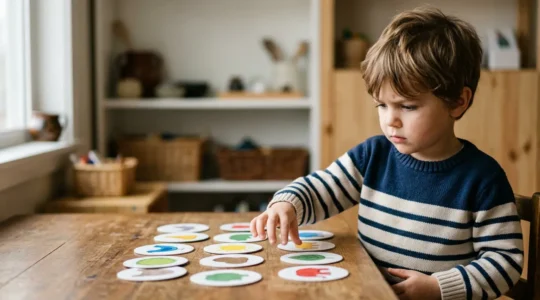
Memory Matching Games: How to Improve Your Child’s Attention Span in 10 Minutes a Day?
Memory games are a clinical tool disguised as play, directly training the core cognitive skill—working memory—that governs a child’s ability to pay attention. The simple act of holding a card’s location and image in mind strengthens the brain’s « mental notepad, »…
Lire la suite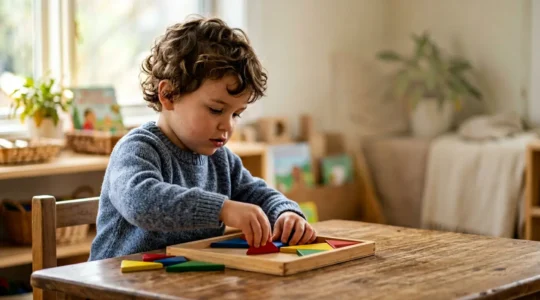
Logic Puzzles for Preschoolers: Building Persistence When a Puzzle Is « Too Hard »
When a preschooler declares a puzzle « too hard » and gives up, the parental instinct is to help them find the piece. This guide offers a more powerful approach: transforming you from a simple helper into a resilience coach. By understanding…
Lire la suite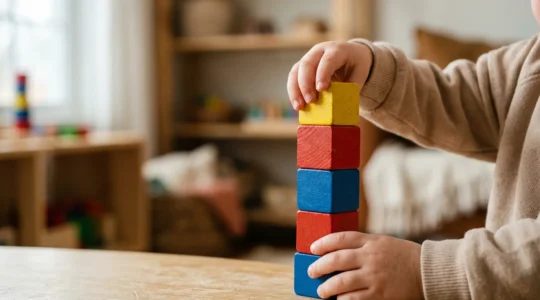
STEM Toys for Toddlers: Unlocking Coding Concepts, No Screens Required
You don’t need expensive coding robots to teach your toddler computational thinking; the most powerful tools are likely already in their toy box. Classic toys like marble runs, blocks, and puzzles are natural environments for learning core coding skills like…
Lire la suite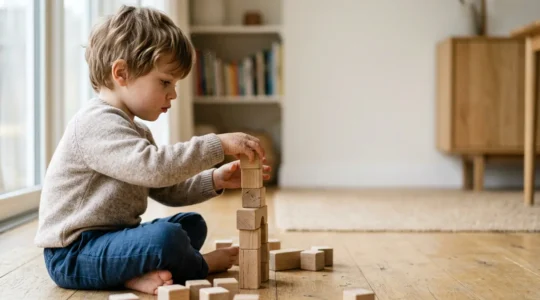
Educational Toys: Why « Open-Ended » Toys Foster More Creativity Than Battery-Operated Ones?
The most « educational » toy is not one that teaches, but one that invites the child to become the teacher. Fewer, simpler toys lead to deeper, more imaginative play by reducing cognitive load. The prepared environment—how toys are displayed and rotated—is…
Lire la suite
Encouraging Physical Growth: How to Help Your Baby Crawl Without Forcing It?
The secret to helping your baby crawl is not to teach crawling itself, but to build the foundational skills—core strength, motor planning, and sensory awareness—that make crawling an inevitable discovery. Common devices like walkers can actively hinder development by weakening…
Lire la suite
Boosting Language Acquisition: Why Narrating Your Day Builds a Toddler’s Vocabulary
The simple act of talking with your child, even before they can talk back, is not just chatter—it’s the active construction of their brain’s language centers. Interactive « conversational turns, » not just the number of words, are what activate key brain…
Lire la suite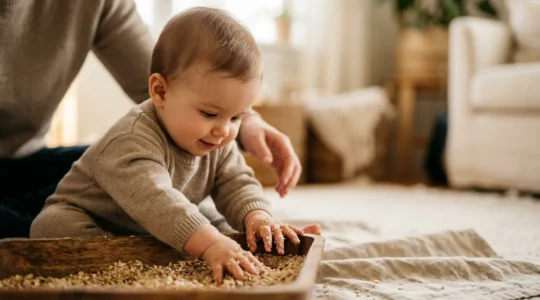
DIY Sensory Play: Creating Safe, Brain-Building Texture Bins for Babies Under One
The fear of choking shouldn’t prevent your baby from the essential brain-building benefits of sensory play; the solution is to engineer a « taste-safe » environment where mouthing is part of the learning. Early sensory experiences physically build the brain’s architecture, forming…
Lire la suite