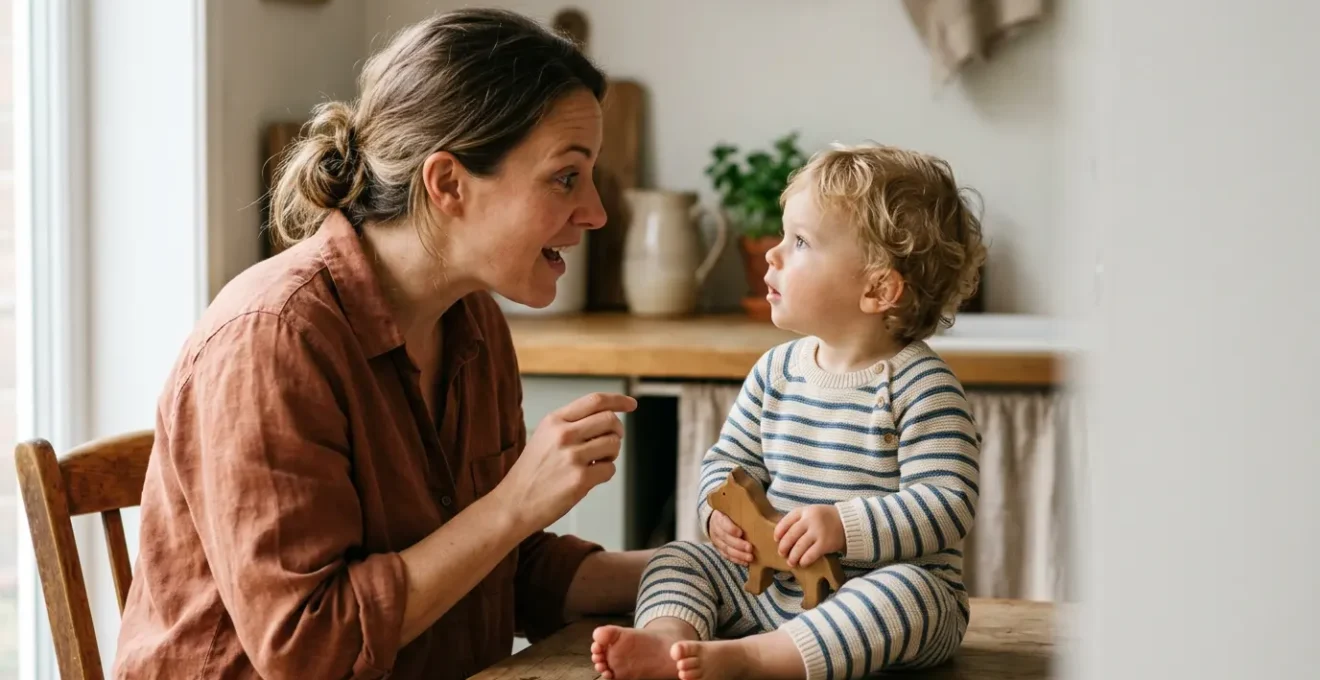
The simple act of talking with your child, even before they can talk back, is not just chatter—it’s the active construction of their brain’s language centers.
- Interactive « conversational turns, » not just the number of words, are what activate key brain regions for language.
- Common myths, like sign language delaying speech, are unfounded; early communication in any form is beneficial.
Recommendation: Shift your focus from feeling silly during one-way monologues to seeing every interaction as a powerful « cognitive deposit » into your child’s future.
If you’ve ever felt a bit foolish narrating your grocery shopping to a baby who can only gurgle in response, you are not alone. Many parents wonder if their one-sided conversations are disappearing into the ether. It’s a natural concern, especially when you see other toddlers chatting away and you’re anxiously awaiting that first « mama » or « dada. » The common advice is to « talk more, » « read often, » and « limit screens, » but this often misses the most crucial piece of the puzzle, leaving parents feeling like they’re just going through the motions without understanding the real impact.
But what if that feeling of silliness is a misunderstanding of what’s truly happening? What if every word you say, every question you ask into the silence, isn’t a monologue but the first half of a critical developmental dialogue? The science is clear: the key to unlocking a child’s linguistic potential isn’t just about the quantity of words they hear, but the quality of the interactions they experience. You aren’t just talking; you are building the very neural architecture that will support their learning and academic success for years to come.
This guide reframes that « silly » feeling by revealing the powerful science behind your daily chatter. We will explore how these early interactions predict later success, provide concrete techniques to make reading more engaging, debunk common myths about speech development, and show you how to transform everyday moments into powerful language-building opportunities. It’s time to see your role not as a narrator, but as a brain architect.
In this article, we’ll explore the foundational science and practical strategies that turn everyday interactions into powerful learning moments. You’ll discover concrete methods to enrich your child’s language environment from pregnancy through their early school years.
Summary: A Practical Guide to Building Your Child’s Vocabulary
- Why Early Exposure to Words Predicts Academic Success at Age 9?
- How to « Dialogic Read » to Engage Your Child in the Story?
- Sign Language or Speech: Does Signing Delay Verbal Communication?
- The Background TV Error That Reduces Parent-Child Conversation by 80%
- How to Use Nursery Rhymes to Teach Phonological Awareness?
- How to Talk to Your Bump to Start Language Bonding Early?
- How to Turn School Commutes Into Prime Bonding Time?
- Imaginative Role-Play: Why « Playing Doctor » Helps Kids Process Medical Anxiety?
Why Early Exposure to Words Predicts Academic Success at Age 9?
The connection between a toddler’s vocabulary and their later academic performance isn’t just a coincidence; it’s a matter of brain construction. For decades, researchers have highlighted the « word gap » between children from different socioeconomic backgrounds. However, groundbreaking new science shows it’s not simply a numbers game. The real magic happens in the back-and-forth of conversation, what experts call « conversational turns. »
This isn’t about you delivering a monologue. It’s about creating a loop: you speak, and your child responds—even with a kick, a coo, a point, or a glance. When you respond to their non-verbal cue, you complete the turn. Groundbreaking MIT research demonstrates that children experiencing more conversational turns with adults exhibited greater activation in Broca’s area, the brain’s language-processing hub. This activation, in turn, directly predicted their verbal skills. In essence, these early « chats » are like workouts for the developing brain, strengthening the neural pathways for language.
This visual metaphor of neural pathways highlights how every interaction helps build a more complex and efficient language network. As Dr. Dana Suskind, a leading expert in the field, explains, the focus should be on the power of these exchanges.
In essence, the 30-million-word gap is really a metaphor for the power of parent language and adult-child interactions.
– Dr. Dana Suskind, Contemporary Pediatrics
This understanding transforms your role. You are not just filling a void with words; you are actively engaging in a process that builds a robust foundation for reading, comprehension, and critical thinking skills that will serve your child nearly a decade later. Every serve-and-return interaction is a long-term investment.
How to « Dialogic Read » to Engage Your Child in the Story?
We all know reading to our children is important, but it’s easy to fall into the habit of simply reading the words on the page while your child passively listens. To truly boost language development, you can transform storytime from a monologue into a dialogue. This powerful, research-backed technique is called dialogic reading, and it involves making the child an active participant in telling the story.
Instead of just reading, you become a conversational partner. You prompt the child to talk about the book, ask questions, and relate the story to their own life. This interactive approach does more than just teach new words; it builds comprehension, narrative skills, and critical thinking. The good news is that it’s a simple shift in mindset, and research shows the results are significant. Studies involving hundreds of children have found that kids can jump ahead by several months in their language development after just a few weeks of dialogic reading.
A helpful way to implement this is by using the CROWD framework, a set of five types of prompts to encourage conversation during reading.
The CROWD Prompt Framework for Dialogic Reading
- Completion prompts: Leave a blank at the end of a sentence for the child to fill in, which works wonderfully with rhyming books or stories with repetitive phrases (e.g., « Brown bear, brown bear, what do you…? »).
- Recall prompts: Ask questions about what happened earlier in a book you’ve already read together to strengthen their memory and understanding of sequence.
- Open-ended prompts: Encourage your child to use their own words to describe what’s happening in the pictures (e.g., « Tell me what’s going on in this picture. »).
- Wh- questions: Ask who, what, where, when, and why questions to build their vocabulary and deepen their comprehension of the story’s elements.
- Distancing prompts: Help your child connect the story to their own life experiences, which makes the story more meaningful (e.g., « This reminds me of when we went to the farm. Do you remember the… ? »).
By using these prompts, you turn a simple story into a rich, interactive experience. You’re not just reading a book; you’re building a brain, one conversation at a time.
Sign Language or Speech: Does Signing Delay Verbal Communication?
One of the most persistent worries for parents exploring early communication is the myth that teaching a baby sign language will delay their spoken language. It’s a logical fear: if they can communicate with their hands, will they lack the motivation to learn to talk? The answer from a wealth of modern research is a resounding and reassuring no. In fact, the opposite is often true.
Think of language as a broad concept that isn’t limited to speech. For a baby, any method that allows them to express their needs and thoughts—whether signed or spoken—is a victory. Signing gives pre-verbal infants a powerful tool to communicate, reducing frustration for both baby and parent. It bridges the gap between what they want to say and what their developing vocal cords can yet produce. This early ability to communicate successfully actually supports the cognitive underpinnings of all language.
Case Study: The NIH-Funded Baby Sign Study
In a landmark longitudinal study, researchers Drs. Acredolo and Goodwyn compared infants taught signs with a control group exposed only to speech. The results were striking. The signing group demonstrated better language skills than their non-signing peers. In a follow-up when the children were 8 years old, the study revealed that the children who had learned to sign as infants had, on average, IQs that were 12 points higher than their non-signing counterparts, demonstrating a powerful long-term cognitive advantage.
This is further supported by robust scientific reviews. Far from being a hindrance, early signing is just another form of language exposure. A systematic review published in the Journal of Speech, Language, and Hearing Research concluded there was no effect of sign language on spoken language development. The study noted that any research claiming a negative relationship was of poor quality. The consensus is that early exposure to language, in any form, supports the development of crucial cognitive skills. It gives your child another pathway to express themselves, building their confidence as a communicator long before their first words emerge.
The Background TV Error That Reduces Parent-Child Conversation by 80%
In our hyper-connected world, the television is often on, providing background noise while we go about our day. Many parents assume that as long as their child isn’t actively watching, it’s harmless. However, research reveals this « auditory clutter » is one of the most significant, and often invisible, saboteurs of early language development. When a TV is on in the background, the quantity and quality of parent-child interactions plummet.
The issue isn’t just about the screen being a distraction for the child; it’s a major distraction for the parent. The constantly shifting sounds and images of a television program, even one you’re not invested in, automatically capture a slice of your cognitive bandwidth. This makes you less available for the rich, responsive « conversational turns » that are so critical for your child’s brain development. Your utterances become shorter, you introduce fewer new words, and you are less likely to respond to your child’s bids for attention.
A controlled study confirmed the dramatic impact of this environmental noise. Researchers observed that in the presence of background TV, both the number of words parents spoke and the number of new words introduced per minute decreased significantly. This means the language environment becomes impoverished. The solution is simple but requires conscious effort: turn the TV off when no one is actively watching. Create a calmer, quieter space that invites interaction rather than competing with it. This single change can dramatically increase the opportunities for meaningful connection and language growth throughout the day. It’s about consciously curating a rich and responsive auditory world for your child.
Your 5-Step Daily Language Environment Audit
- Identify Noise Sources: List all sources of background noise in your main living areas (TV, radio, podcasts, notifications on devices). When are they typically on?
- Track Interaction « Deserts »: For one hour, consciously notice when you are in the same room as your child but not interacting. Is a device or background noise the primary cause?
- Evaluate Your « Serve and Return »: For 15 minutes, focus only on responding to every coo, point, or sound your child makes. Notice how this feels and how your child reacts. Is this easier with the TV off?
- Implement « Quiet Time »: Schedule at least one 30-minute block of « no-tech » playtime each day. Observe the difference in the quality of your play and conversation.
- Create a Plan for Intentional Sound: Replace background TV with intentional audio like music you can sing to together or a story-based podcast during car rides. Make sound a tool for connection, not distraction.
How to Use Nursery Rhymes to Teach Phonological Awareness?
Nursery rhymes are far more than just charming traditions passed down through generations; they are a powerhouse tool for developing phonological awareness. This is the ability to recognize and work with the sounds in spoken language, and it is one of the most important pre-reading skills a child can develop. The rhythm, rhyme, and repetition in classics like « Twinkle, Twinkle, Little Star » or « Humpty Dumpty » are not accidental—they are perfectly designed to train a child’s ear to the patterns of language.
When you sing a rhyme, you are naturally emphasizing syllables and highlighting the sounds that make up words. This playful exposure helps your child’s brain begin to distinguish individual phonemes (the smallest units of sound), a skill that is foundational for learning to decode words when they begin to read. Clapping along to the beat or doing associated actions adds a kinesthetic layer, helping to cement these auditory patterns in their memory. It’s an incredibly effective and joyful way to build a strong base for literacy.
The beauty of nursery rhymes is that they can be adapted to your child’s developmental stage, growing in complexity as they do. What starts as simple listening for a baby can evolve into an interactive game for a preschooler.
Age-Progressive Nursery Rhyme Activities
- For babies (6-12 months): The focus should be entirely on rhythm and melody. Bounce, clap, or sway with your baby as you sing. Your soothing voice and the gentle motion build a positive association with the patterns of language.
- For toddlers (12-24 months): Start playing with expectation. Pause just before the final rhyming word and look at your child expectantly (e.g., « Twinkle, twinkle, little… »). Their attempt to fill in the blank is a huge developmental step.
- For preschoolers (3-5 years): Challenge them to get creative. Ask them to invent new rhymes using family members’ names or favorite toys (« Silly, silly, Daddy… »). This encourages them to actively manipulate sounds.
- Cross-age strategy: Explore rhymes from your own cultural heritage or that of your family. This not only teaches sound patterns but also strengthens intergenerational bonds and a sense of identity.
By integrating these simple, playful activities into your day, you are giving your child a profound gift. You are tuning their ears to the music of language, preparing them for the day when they will translate those sounds into words on a page.
How to Talk to Your Bump to Start Language Bonding Early?
The journey of language acquisition doesn’t begin with the first word, or even at birth. It starts in the quiet, fluid world of the womb. Around 18 weeks of gestation, a baby’s ears are structurally complete, and by 24 weeks, they are beginning to respond to sounds. While they can’t make out specific words, they are incredibly attuned to the rhythm, pitch, and melody—the prosody—of the voices around them, especially their mother’s.
When you talk, read, or sing to your bump, you are giving your baby their very first language lesson. The amniotic fluid muffles higher frequencies, but it transmits lower-frequency sounds beautifully. This means the musicality of your voice and the steady, rhythmic beat of your heart become the primary « language » your baby learns. This early exposure helps the developing auditory system begin to organize itself, laying the neural groundwork for processing spoken language after birth. In fact, studies show that newborns can recognize their mother’s voice and even prefer it over others.
Feeling silly talking to your stomach is common, but it helps to reframe the activity. You aren’t performing for an audience; you are bonding and building a foundation. You don’t need to have profound conversations. Simply narrate your day, read a chapter of a book out loud, or sing your favorite songs. This creates a familiar and soothing soundscape for your baby. Research on prenatal auditory processing confirms that the rhythm and musicality of the mother’s voice are the first linguistic patterns the baby learns.
This early start also has benefits for you. It helps foster a sense of connection and bonding long before you can hold your baby in your arms. It’s a simple, gentle way to begin your parenting journey, transforming an abstract idea into a tangible relationship. So, the next time you chat with your bump, know that you are doing important work: creating a loving, language-rich environment from the very beginning.
How to Turn School Commutes Into Prime Bonding Time?
As children grow older and start school, the frantic morning rush and tired afternoon pickup can feel more like logistical challenges than opportunities for connection. The default question, « How was your day? » is often met with a one-word answer: « Fine. » However, the daily commute, whether it’s a five-minute drive or a thirty-minute bus ride, offers a unique, contained opportunity for the kind of rich, narrative conversation that builds vocabulary, emotional intelligence, and a strong parent-child bond.
The key is to replace generic questions with specific, engaging prompts that invite storytelling. Instead of asking a question that can be answered with a simple « yes » or « no, » aim for open-ended inquiries that require your child to recall events, describe feelings, and structure a narrative. This doesn’t just improve their language skills; it helps them process their day and strengthens their executive function skills, like sequencing and working memory. It also shows them that you are genuinely interested in the details of their world.
For example, using a simple framework can make this much easier. A popular technique among child development experts is the « Rose, Thorn, Bud » method. You ask your child to share one good thing from their day (the rose), one challenging or difficult thing (the thorn), and one thing they are looking forward to (the bud). This structure gives them a clear and safe way to share both the highs and lows. Another strategy is « narrative forecasting »—using the drive home to plan the evening together (« When we get home, what’s the first thing you want to do? »). This builds anticipation and teaches planning skills.
By being intentional, you can transform this often-overlooked time into one of the most valuable moments of your day. It becomes a predictable ritual of connection, a time when you put away distractions and focus entirely on the stories your child has to tell. You’re not just getting from point A to point B; you’re building a bridge into your child’s inner world.
Key Takeaways
- Focus on interactive « conversational turns » rather than just the number of words your child hears.
- Use dialogic reading techniques like the CROWD prompts to make storytime an active dialogue.
- Embrace early communication tools like sign language, as they support cognitive development without delaying speech.
Imaginative Role-Play: Why « Playing Doctor » Helps Kids Process Medical Anxiety?
For a young child, a visit to the doctor’s office can be a confusing and frightening experience filled with unfamiliar instruments, strange sensations, and a sense of powerlessness. While we use language to explain and reassure them, one of the most effective tools for helping children process these big feelings is not talking, but playing. Imaginative role-play, especially « playing doctor, » provides a safe and controlled way for children to understand and master their anxieties.
When a child picks up a toy stethoscope or pretends to give a doll a shot, they are doing more than just mimicking. They are stepping into the role of the person in charge. This reversal of roles is incredibly empowering. It allows them to move from being the passive recipient of a medical procedure to the active director of it. In this play, they are the one holding the instrument, making the decisions, and controlling the outcome. This sense of agency is crucial for processing fear and trauma. It turns a scary, unpredictable event into a familiar, manageable script.
This type of play is also a powerful language-building exercise. It gives you the opportunity to introduce and normalize medical vocabulary in a low-stakes context. Words like « stethoscope, » « thermometer, » « brave, » and « healthy » become part of a familiar game rather than scary jargon heard only in an intimidating environment. You can model gentle care, explain what each tool is for, and talk through the steps of a check-up, all while your child is in a relaxed and receptive state.
By encouraging this form of imaginative play, you are giving your child a dual gift. You are equipping them with the language to understand their experiences and the emotional tools to feel in control of them. You are helping them build a narrative of competence and resilience, turning a source of anxiety into a story where they get to be the hero.
Ultimately, boosting your child’s language acquisition isn’t about following a rigid set of rules or feeling pressured to perform. It’s about a fundamental shift in perspective: from talking *at* your child to interacting *with* them. Every shared story, every answered coo, and every moment of imaginative play is a powerful act of brain-building. By embracing your role as a responsive conversational partner, you are giving your child the most profound gift—a strong foundation for a lifetime of learning, communication, and connection.