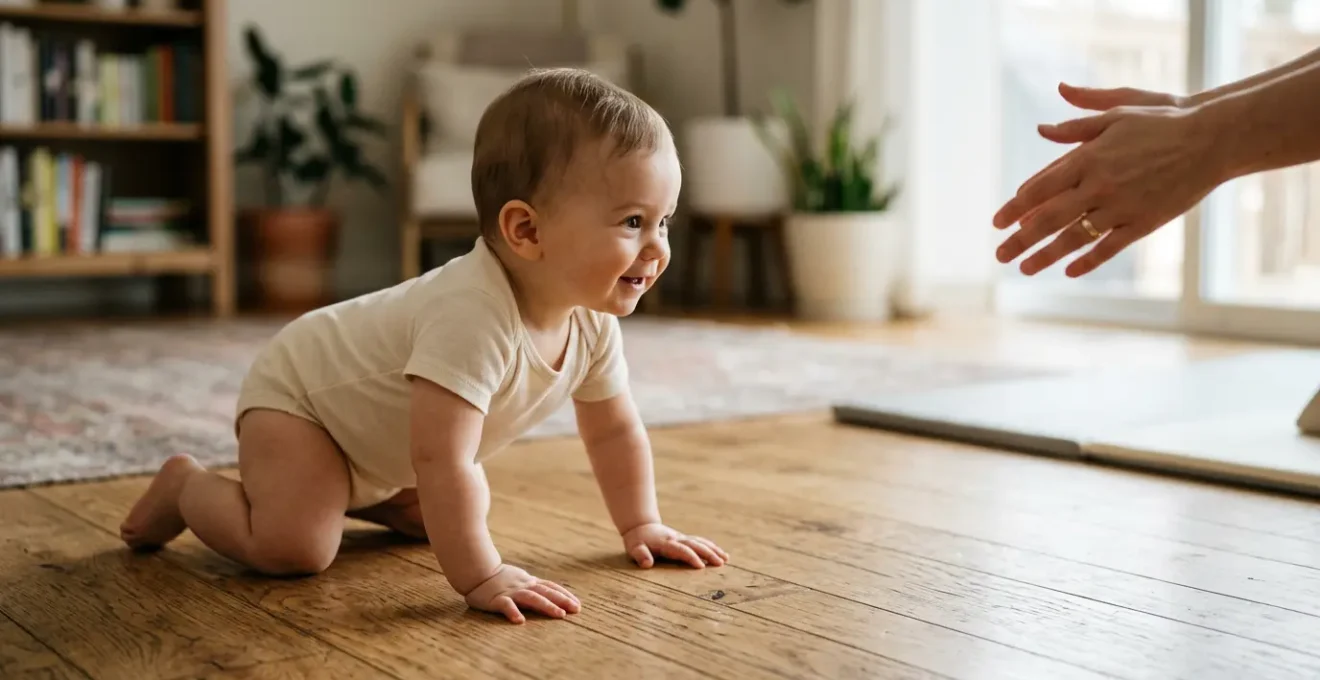
The secret to helping your baby crawl is not to teach crawling itself, but to build the foundational skills—core strength, motor planning, and sensory awareness—that make crawling an inevitable discovery.
- Common devices like walkers can actively hinder development by weakening core control and providing improper feedback.
- Barefoot time and play on unstable surfaces (like couch cushions) are powerful, free tools for building a strong, intelligent body.
Recommendation: Shift your focus from the milestone to the process. Create a safe, engaging floor environment and trust that by supporting the building blocks, you are giving your child exactly what they need to move forward.
As a parent, watching your baby approach their first major milestones is a uniquely thrilling experience. When the wiggles and rolls start hinting at crawling, it’s natural to want to help them along. The internet is filled with advice, often boiling down to more tummy time or dangling a favorite toy just out of reach. While well-intentioned, this eagerness can sometimes lead us to focus on the finish line—crawling—without understanding the crucial journey the body must take to get there.
The common perception is that crawling is just a simple step before walking. Many parents might even feel a sense of urgency, comparing their child’s progress to others or considering aids like walkers to « speed things up. » But what if the true key to encouraging movement wasn’t about pushing your baby toward a milestone, but about methodically building the physical and neurological foundation that makes crawling a natural, joyful consequence? This approach, rooted in pediatric physiotherapy, shifts the goal from forcing a specific skill to creating a rich environment that fosters core strength, sensory processing, and motor planning.
This guide will move beyond the generic tips. We will explore the deep connection between crawling and future academic skills, deconstruct common sitting errors that sabotage core strength, and provide practical, safe ways to use your everyday environment—from couch cushions to car seats—as a developmental playground. By the end, you won’t just have a list of tricks; you will have a new lens through which to see and support your child’s incredible journey of movement.
This article will guide you through the essential components of supporting your baby’s gross motor development. Below is a summary of the key areas we will explore to help you foster natural, confident movement in your child.
Summary: Encouraging Physical Growth: A Guide to Natural Crawling
- Why Crawling Is Essential for Reading Skills Later in Life?
- How to Use Toys to Motivate Your Baby to Reach and Roll?
- The Sitting Position Error That Weakens Core Muscles
- How to Use Couch Cushions to Build Core Strength in Toddlers?
- Walkers or Activity Centers: Which Device Is Safer for Hip Development?
- When to Buy Shoes: Why Barefoot Is Best for New Walkers?
- DIY Sensory Play: How to Create Safe Texture Bins for Babies Under 1 Year?
- How to Engage Your Core While Lifting the Car Seat to Protect Your Back?
Why Crawling Is Essential for Reading Skills Later in Life?
The link between a baby crawling on the floor and a child reading a book may seem tenuous, but from a neurodevelopmental perspective, they are profoundly connected. Crawling is not just a means of getting from point A to point B; it is a critical engine for brain development. The most significant aspect of this is the cross-lateral movement—the coordinated action of moving an opposite arm and leg simultaneously. This motion requires both hemispheres of the brain to communicate intensely with each other.
This communication happens across a thick bundle of nerve fibers called the corpus callosum. Every time a baby crawls, they are strengthening this neural bridge. A more robust and efficient corpus callosum allows for faster and more integrated processing of information between the logical left brain and the creative right brain. This integration is fundamental for complex cognitive tasks later in life, including reading, which requires decoding symbols (left brain) and understanding narrative and context (right brain).
In fact, research demonstrates that individuals with high IQs who perform well academically often have a demonstrably thick and well-developed corpus callosum. While not every child who skips crawling will have reading difficulties, embracing the crawling phase provides an unparalleled opportunity to build a powerful neurological foundation for a lifetime of learning. It’s a clear example of how early physical experiences sculpt the architecture of the mind.
How to Use Toys to Motivate Your Baby to Reach and Roll?
Before a baby can crawl, they must master the foundational movements of reaching and rolling. These actions build the initial core strength, trunk rotation, and body awareness necessary for more complex locomotion. Toys are a fantastic tool to encourage these skills, but the strategy is more nuanced than simply placing a favorite object nearby. The key is to use the « Zone of Proximal Motivation »—placing a single, highly engaging toy just beyond their current comfortable reach.
This sweet spot encourages the baby to problem-solve. It’s close enough to maintain their interest but far enough to require genuine effort—a slight weight shift, a pivot, or the beginnings of a roll. Overwhelming a baby with a dozen toys can be counterproductive, leading to overstimulation or distraction. A single, captivating item focuses their intent and motivation. Rotate the toy selection regularly to maintain novelty without creating clutter.
Remember that you are your baby’s most interesting « toy. » Get down on the floor at their level. Your voice, facial expressions, and gentle games like peek-a-boo can be powerful motivators for them to turn their head, pivot their body, and eventually roll towards you. Celebrate the small efforts—the reach, the strain, the weight shift—as much as the successful roll. This builds intrinsic motivation and reinforces that movement is a joyful, rewarding experience.
A Strategic Approach to Toy Motivation:
- Place toys just outside the baby’s current reach zone, requiring effort to obtain.
- Use a single highly engaging sensory toy (crinkly, high-contrast, gentle sounds) to focus their attention.
- Rotate toys to maintain novelty and motivation without overwhelming the baby.
- Position yourself as the « ultimate toy » by getting on the floor, using your face and voice to engage them.
- Play games that encourage the baby to pivot, roll, or reach toward you.
- Celebrate small efforts (like weight shifting) as much as big achievements to build intrinsic motivation.
The Sitting Position Error That Weakens Core Muscles
As babies gain the ability to sit up, parents rightfully celebrate this new milestone of independence. However, one common sitting posture can unintentionally undermine the development of the very muscles needed for crawling and walking: the « W-sit. » In this position, the child sits with their bottom on the floor between their legs, which are bent and splayed out to the sides, forming a ‘W’ shape. While it may look stable, it’s a developmental trap.
The problem with W-sitting is that it creates an artificially wide and stable base of support. As pediatric physical therapists explain that when a child W-sits, it’s easier to stay upright without activating crucial postural and core musculature. The body is resting on the joint structures rather than engaging the muscles. This lack of core engagement discourages the development of trunk rotation and the ability to shift weight from side to side—two essential skills for moving in and out of sitting, crawling, and eventually, walking.
This paragraph introduces the concept of healthy sitting alternatives. To better understand this, the illustration below showcases beneficial positions.
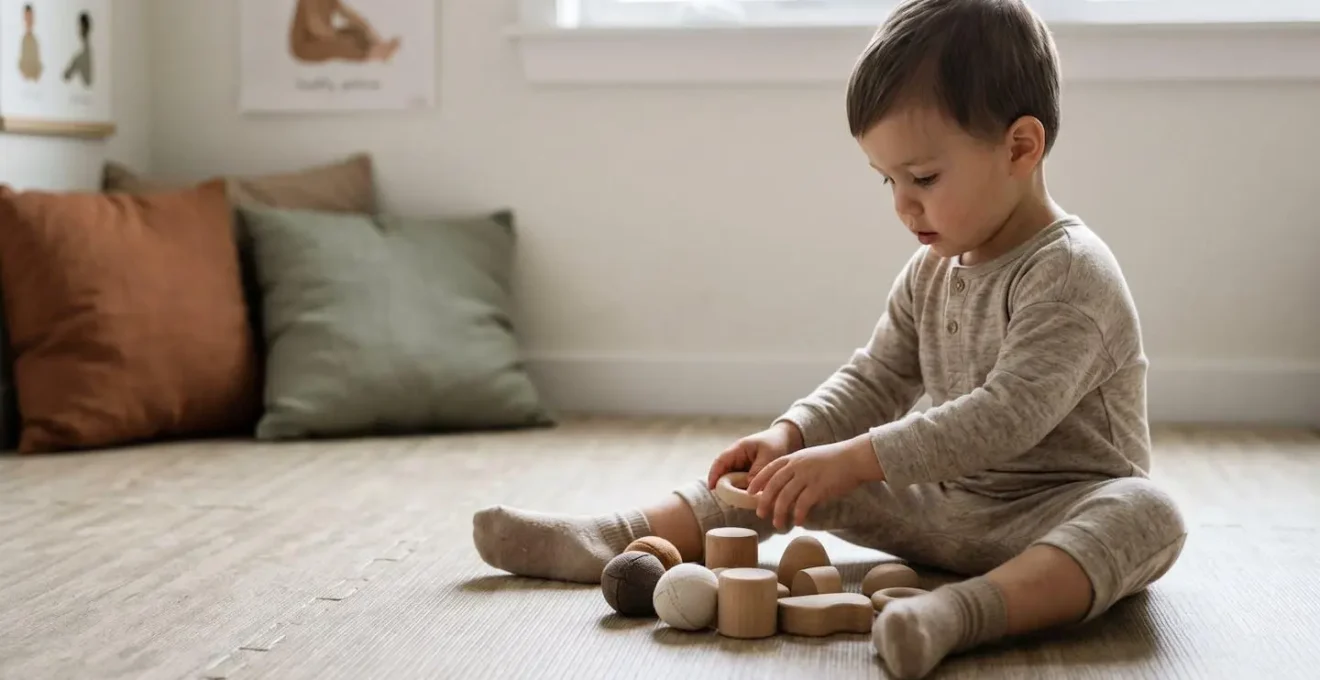
Encourage alternative sitting postures that build strength. These include the « ring sit » (legs form a circle in front), « side sit » (both legs bent to one side), or long-sitting (legs straight out). These positions have a smaller base of support, forcing the core muscles to engage to maintain balance. If you see your child in a W-sit, gently redirect their legs into one of these more beneficial positions. This simple correction helps build a strong foundation for a lifetime of healthy movement.
How to Use Couch Cushions to Build Core Strength in Toddlers?
Your living room can be the perfect gymnasium for your developing baby, and your couch cushions are the ideal equipment. Creating a « proprioceptive playground » with cushions provides a safe, engaging way to build core strength, motor planning skills, and balance. An unstable surface, even a gentle one, requires a child’s brain and body to work together in a sophisticated way. It forces them to constantly make micro-adjustments, engaging their trunk and hip muscles to maintain stability.
This isn’t just about muscle; it’s about the brain. Navigating a mini-mountain of cushions is a complex problem-solving task. The child must assess the terrain, plan their movements, and execute the sequence of pushing, pulling, and balancing to get across. This is motor planning in action. The soft, forgiving nature of cushions provides rich proprioceptive input—the sense of where the body is in space—without the risk of a hard fall.
The following image shows how a simple cushion arrangement can challenge a toddler’s balance and core engagement in a playful setting.
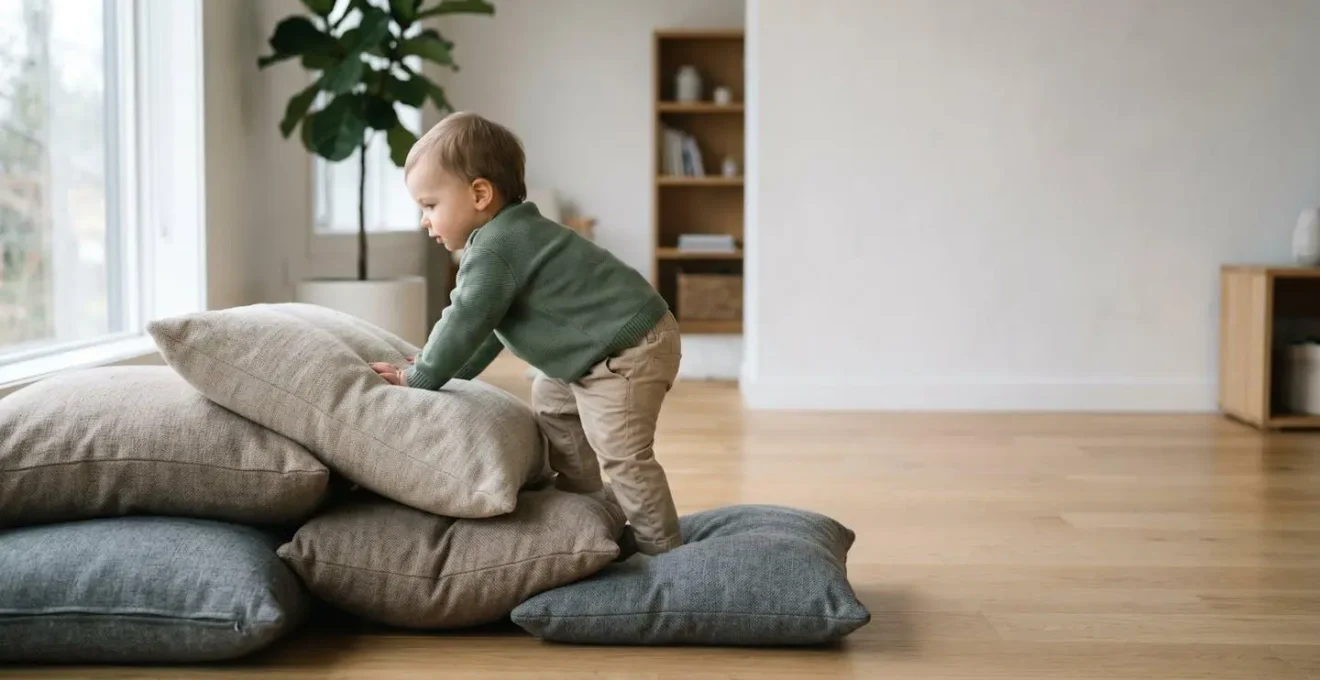
The key is to tailor the challenge to your child’s developmental stage. For a pre-crawler, a single firm cushion can create a gentle slope to push up against during tummy time, strengthening their arms and shoulders. For an active crawler, a small pile of cushions becomes a mountain to conquer. For a new walker, a line of cushions forms a « wobbly bridge » to cruise along, perfecting their balance. Always supervise closely and ensure the play area is away from hard edges or stairs.
Walkers or Activity Centers: Which Device Is Safer for Hip Development?
In the quest to encourage mobility, many parents turn to devices like baby walkers. However, pediatric health experts are united in their advice: avoid mobile walkers. They are not only dangerous— in 2014, 2,000 toddlers were seen in emergency rooms for walker-related injuries—but they can also actively interfere with healthy motor development. Walkers allow babies to move before they are developmentally ready, often encouraging them to push off with their toes, which can lead to tight heel cords. More importantly, the sling seat supports the baby’s weight, preventing them from engaging their core and learning proper balance and weight transfer.
Stationary activity centers or « exersaucers » are a relatively safer alternative, as they eliminate the mobility-related injury risk. However, they are not without developmental concerns. When a baby is placed in an activity center, they are often suspended in a way that doesn’t allow their feet to be flat on the floor or bear their full weight correctly. This can still disrupt the natural development of posture and balance. The fundamental rule is that floor time is always superior to « container » time.
Case Study: The Impact of Baby Walkers on Motor Development
A 2021 study in Turkey provided clear evidence of the negative effects of walkers. Researchers compared 29 infants who used baby walkers with 19 who did not. At 10 months of age, the infants in the walker group had significantly lower scores in both overall motor development and trunk balance. The study concluded that walkers adversely affect motor development because the infant rests their hips and trunk on the fabric seat, failing to engage the core muscles needed for control and proper weight transfer, thereby delaying the very milestones the device is purported to encourage.
If you choose to use a stationary activity center, it should be done with strict limitations and adherence to safety guidelines to minimize any negative impact on development.
Your Safety Checklist for Activity Centers
- Ensure baby’s feet are completely flat on the floor, not on tiptoes, by adjusting the height.
- Limit use to a maximum of 15 minutes per session, and no more than twice per day.
- Only begin using after the baby can sit unassisted without any support (typically 6+ months).
- Choose models that do not rotate a full 360 degrees to encourage the baby to use their own trunk muscles for natural rotation and turning.
- Never allow it to become a substitute for essential free-play floor time and tummy time activities.
When to Buy Shoes: Why Barefoot Is Best for New Walkers?
One of the most frequent questions parents have as their child begins to pull up and cruise is, « When should we buy shoes? » The answer from a developmental perspective is simple: delay as long as possible. For a new walker, being barefoot indoors is not just acceptable; it’s optimal. The foot is a complex biomechanical marvel and a rich sensory organ, and shoes can interfere with both of these functions.
The sensory aspect is profound. Research reveals that there are as many as 200,000 nerve endings in the sole of a single foot. This massive network of nerves provides the brain with a constant stream of information about texture, pressure, and the surface the child is walking on. This proprioceptive feedback is essential for developing balance, a natural gait, and spatial awareness. Stiff, supportive shoes act like thick gloves, dulling this crucial sensory information and robbing the brain of the data it needs to learn.
When shoes are necessary for protection outdoors, the philosophy should be « as little as possible. » The first shoe’s only job is to protect the sole of the foot from sharp or unsafe surfaces. It should not be to « support » the ankle or « form » the arch. A healthy foot develops its own strength and arch through use. When choosing that first pair, the criteria should prioritize flexibility and freedom of movement above all else.
Checklist for a Child’s First Shoe:
- Sole Flexibility: The shoe must have a fully flexible sole that you can easily bend and twist completely in half with your hands.
- Wide Toe Box: The front of the shoe must be wide enough to allow the toes to spread out naturally, just as they would when barefoot.
- Zero-Drop Design: There should be no heel elevation. The foot should remain flat from heel to toe to promote a natural posture.
- Lightweight Construction: The shoe should be as light as possible, adding no unnecessary weight to developing feet and legs.
Key takeaways
- True motor development is about building foundational skills like core strength and sensory awareness, not just achieving a milestone.
- Floor time is the most valuable tool; devices like walkers can be detrimental, while even stationary activity centers require strict limits.
- Natural is best: encourage barefoot walking indoors and protect your own body by using proper lifting mechanics.
DIY Sensory Play: How to Create Safe Texture Bins for Babies Under 1 Year?
Sensory exploration is a cornerstone of infant development, intrinsically linked to motor skills. As babies learn to reach, grasp, and bring objects to their mouths, they are also building a rich understanding of the world through touch, taste, and texture. Creating a « sensory bin » is a wonderful way to facilitate this learning, but for babies under one, safety is paramount. The solution is to use edible, taste-safe fillers, transforming the activity into a multi-sensory feast.
The goal is not for the baby to have a meal, but to ensure that the inevitable mouthing of materials is completely safe. This approach allows for free, uninhibited exploration. Spreading plain yogurt on a highchair tray or offering a bowl of cooled, cooked pasta allows a baby to squish, smear, and grasp, experiencing a range of textures while developing fine motor skills. These simple activities provide immense tactile input, helping the brain to organize and process sensory information.
When setting up edible sensory play, keep it simple and supervised. A shallow layer of material in a bowl or on a highchair tray is all that is needed. Limit sessions to 10-15 minutes to prevent overstimulation and keep the experience positive and engaging. This is not just « messy play »; it is a foundational learning experience that nurtures curiosity and builds critical brain-body connections.
Safe & Edible Sensory Fillers for Babies:
- Cooked Pasta: Cooled shapes like penne, fusilli, or large shells are great for grasping practice.
- Plain Yogurt: Spread a thin layer on a highchair tray for a smooth, cool tactile experience.
- Cooked Oatmeal: Cooled oatmeal or cream of wheat provides a safe, grainy texture for exploration.
- Water Play: A very shallow layer (1-2 inches) of water with large, safe items like lemon slices offers visual and tactile fun under strict supervision.
- Mashed Veggies/Fruits: Mashed avocado, banana, or sweet potato are perfect for smearing and squishing.
- Large Cooked Vegetables: Soft, large pieces of broccoli florets or carrot sticks allow for safe mouthing and exploration.
How to Engage Your Core While Lifting the Car Seat to Protect Your Back?
As a parent, you spend a significant amount of time lifting and carrying—not just your baby, but also their gear. The infant car seat, while a safety essential, is notoriously awkward and heavy, making it a primary culprit for parental back pain. Protecting your own body is a crucial, yet often overlooked, part of caring for your child. Applying a simple physiotherapy technique—the hip hinge with core bracing—can transform this daily chore into a safe, strengthening movement.
The most common mistake is bending from the waist, rounding the back to pick up the seat. This puts immense strain on the vulnerable discs and muscles of the lower back. The correct method involves keeping your spine neutral and using the powerful muscles of your hips and legs to do the work. This starts with « bracing » your core: imagine you are about to receive a gentle push to your stomach and tense your abdominal muscles. This creates a « natural corset » that stabilizes and protects your spine.
From there, you perform a hip hinge. Instead of bending your waist, push your hips backward as if trying to tap a wall behind you with your bottom. Keep your chest up and your back straight. Grab the car seat, and then drive your hips forward to stand up, squeezing your glutes. It feels different, but this technique uses your body as it was designed to be used. Practicing this with every lift not only prevents injury but also reinforces good movement patterns for a lifetime of parenting.
A Physio’s Guide to Lifting a Car Seat:
- Brace Your Core: Before you move, take a breath and gently tense your abdominal muscles to create a stable trunk.
- Set Up: Stand close to the car seat with your feet hip-width apart.
- Hip Hinge: Push your hips straight back, keeping your spine neutral and chest lifted. Do not round your back.
- Grip: Hold the handle close to your body’s center.
- Lift: Engage your glutes and hamstrings to drive your hips forward and stand up, keeping your core braced throughout.
- Avoid: Bending at the waist, twisting while lifting, or holding your breath.
Now, you can observe your baby’s movements and support your own body with a new understanding, creating a playful, safe, and strong environment for your entire family’s developmental path.