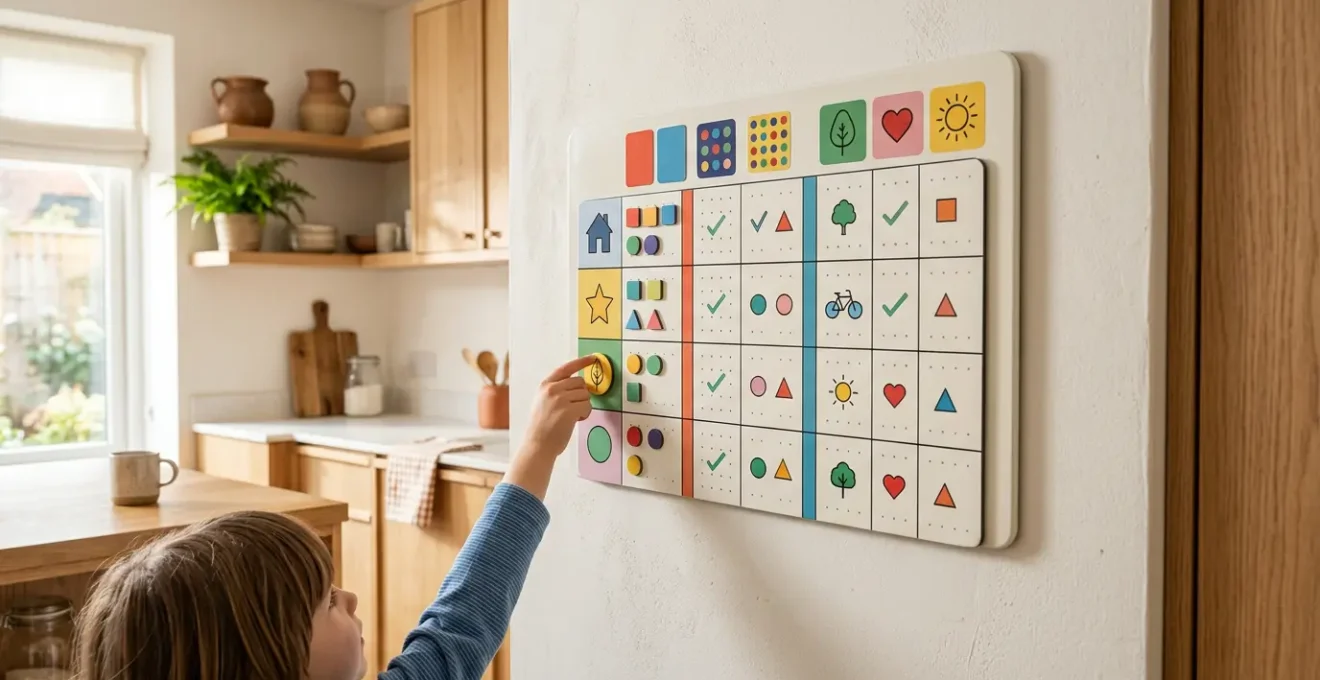
The key to ending household chaos is to stop making chore charts and start building a family-wide executive function system.
- A visual routine isn’t a to-do list; it’s an external tool that reduces parental mental load by distributing cognitive responsibility.
- Effective systems are built on psychological principles that support neurodiversity (like ADHD), are flexible enough to withstand real life, and evolve with the family.
Recommendation: Shift your focus from task completion to system design. Build a visual framework that gives every family member autonomy and a shared sense of team accountability.
The constant refrain of « Did you brush your teeth? » or « Is your backpack ready? » is a familiar soundtrack in many homes. Parents often find themselves in the role of project manager, a draining position that contributes to significant mental load. The common solution is to create a chore chart, often with stickers and rewards, hoping it will magically instill a sense of responsibility. While well-intentioned, these charts frequently fail within weeks, becoming just another piece of ignored wall décor.
The problem is a fundamental misunderstanding of the goal. We try to manage tasks, when we should be managing systems. A truly effective visual routine chart is not a list of chores; it is an externalized executive function system for the entire family. Its purpose is not just to get things done, but to systematically reduce parental cognitive load, build genuine autonomy in children, and create a predictable environment where everyone knows their role. This approach moves beyond simple task management to create a resilient, cooperative family dynamic.
This article will deconstruct the process of building such a system. We will explore the science behind why routines are critical, especially for neurodivergent children, and provide a blueprint for designing, implementing, and adapting a visual framework that actually works. We will cover how to optimize high-stress moments like mornings, choose the right tools, and navigate the inevitable breakdowns, all while fostering a sense of family cohesion that lasts well into the teen years.
Summary: Household Routine Planning: How to Create a Visual Chore Chart That Actually Works?
- Why Routines Reduce Anxiety in Children With ADHD?
- How to Order Morning Tasks to Get Out the Door 10 Minutes Early?
- Apps or Whiteboards: Which Tool Keeps the Family on Track?
- The Flexibility Mistake: What to Do When the Routine Falls Apart?
- How to « Gamify » Chores so Kids Want to Participate?
- The Mistake of Overcommitting That leads to Third Trimester Burnout
- How to streamline the Drop-Off Routine to Avoid Being Late to Work?
- Fostering Family Cohesion: How to Create « Family Traditions » That Teens Will Actually Like?
Why Routines Reduce Anxiety in Children With ADHD?
For any child, predictability creates a sense of safety. For a child with Attention-Deficit/Hyperactivity Disorder (ADHD), it’s a neurological necessity. The ADHD brain often struggles with executive functions—the skills that govern planning, organization, and task initiation. A lack of external structure can lead to overwhelming internal chaos, which frequently manifests as anxiety. In fact, clinical research shows that up to 50% of children with ADHD also meet the criteria for an anxiety disorder.
Routines act as a powerful antidote by externalizing these executive functions. A visual chart doesn’t just remind a child what to do; it provides a clear, sequential, and non-verbal scaffold for their brain. It outsources the mental effort of « What’s next? » and « Am I forgetting something? » to a reliable, external source, freeing up cognitive resources and lowering anxiety.
This isn’t just theory; it’s backed by evidence. A 2023 study on Parental Occupational Executive Training (POET) found that implementing visual routine charts led to significant clinical improvements. The study revealed that after eight sessions, children’s management of daily routines improved significantly, with morning and evening efficiency surpassing published difficulty cutoff scores. The researchers concluded that the visual charts served as « external executive functions, » directly reducing ADHD symptomatology and improving the family’s ability to manage daily life. By creating a predictable flow, we are not just managing behavior; we are calming the nervous system.
How to Order Morning Tasks to Get Out the Door 10 Minutes Early?
The morning rush is a primary stress point for most families. The key to a smoother morning is not to move faster, but to make fewer decisions. An efficient morning routine begins the night before. By front-loading preparation, you eliminate the cognitive load of decision-making and logistical scrambling when time is tight and patience is thin.
The most effective strategy is to establish a « launch station » or « launch pad » near the main exit. This designated zone becomes the central hub for everything needed to leave the house. The evening routine should include a specific task: « Prepare the Launch Pad. » This means packing backpacks, signing forms, choosing outfits, and placing shoes, coats, and keys in their designated spots. The goal is a grab-and-go morning where all thinking has already been done.

As the image above illustrates, an organized launch pad provides a visual confirmation that everything is ready. This approach also includes pre-making breakfasts and lunches to further reduce morning deliberation. To prevent the feeling of being rushed, it’s critical to build in buffer time. A well-paced routine should last between 45 and 60 minutes, with an additional 5-10 minute cushion for the inevitable spilled milk or missing sock. For younger children, a visual chart with pictures is essential, while older kids can use a combination of words and images to guide them through the sequence independently.
Apps or Whiteboards: Which Tool Keeps the Family on Track?
Once you’ve committed to a visual system, the next question is the medium: a physical whiteboard or a digital app? The answer depends entirely on your family’s goals and dynamics. Both tools serve the same fundamental purpose: to provide the visual reminders that research indicates children need to develop confidence and successfully complete responsibilities. However, they achieve this in very different ways.
A physical whiteboard, placed in a central location like the kitchen, creates a shared reality. Its public nature fosters team culture and mutual accountability. The tactile satisfaction of moving a magnet or checking off a task provides an immediate, tangible micro-reward that is highly effective for all ages. It is always visible, requires no device, and can be easily customized. In contrast, digital apps offer individualized nudging through private notifications. They excel at automation, sending reminders, and syncing across multiple devices, making them ideal for families with complex schedules or tech-savvy older children who need remote coordination. The main trade-off is often a subscription cost versus a one-time purchase.
| Feature | Physical Whiteboard | Digital Apps |
|---|---|---|
| Visibility | Central location creates shared reality and public accountability | Private device-based nudging, individual access |
| Engagement | Tactile satisfaction of moving magnets provides immediate micro-reward | Notifications and digital rewards, lower physical friction |
| Accessibility | Always visible, no device needed, works for all ages | Requires device access, better for tech-savvy families |
| Flexibility | Easy to customize with markers and magnets, but requires manual updates | Automated reminders, can sync across devices, integrates with calendars |
| Cost | One-time purchase, low maintenance | Often subscription-based (free basic versions available) |
| Best For | Building team culture and shared family responsibility | Individual task completion and remote coordination |
Ultimately, the best tool is the one your family will consistently use. For building a foundational sense of shared family responsibility, a public whiteboard is often superior. For managing individual task completion for older kids or co-parents, an app might be more efficient. Some families even find success with a hybrid approach.
The Flexibility Mistake: What to Do When the Routine Falls Apart?
One of the biggest mistakes in routine planning is striving for perfection. Life is messy: children get sick, alarms don’t go off, and meltdowns happen. A rigid system will shatter under pressure. A resilient system, however, anticipates chaos and builds in flexibility. The goal isn’t to prevent disruptions but to have a protocol for when they occur.
The first step is proactive brainstorming. As a family, identify common « hiccups » and come up with solutions *before* they happen. This turns a future moment of panic into a pre-planned response. This also means building a buffer zone of 5-10 extra minutes into every routine as a non-negotiable flexibility cushion. When things go awry, the most important response from a parent is to model calm, problem-solving behavior. Instead of reacting with stress, which only escalates the situation, use it as a teaching moment. Encourage critical thinking by asking questions like, « Your blue shirt is missing. What’s another great shirt you could wear today? »

For particularly overwhelming days—like sick days or post-vacation mornings—it’s wise to have a simplified « emergency routine. » This could be a separate, smaller visual chart with only the absolute essential tasks. It gives permission to the family to operate at a lower capacity without abandoning structure entirely. This approach teaches a crucial life skill: how to adapt and persevere when plans change, strengthening emotional connection and resilience in the process.
How to ‘Gamify’ Chores so Kids Want to Participate?
Getting kids to not just do chores, but to *want* to do them, is the holy grail of household management. This is where gamification comes in. It’s more than just a sticker chart; it’s the science of applying game-design elements to non-game contexts to increase engagement and motivation. When done correctly, it transforms tasks from « have-to » obligations into « want-to » challenges.
The science confirms that gamification works because it taps into our brain’s natural reward system. A University of Pennsylvania study found that rewards can increase motivation and engagement by up to 60%. However, the most effective gamification focuses on fostering intrinsic motivation—the desire to do something for its own sake. Research shows that gamified systems are effective because they provide a sense of progress, purpose, and autonomy. Elements like earning points, leveling up, or working towards a shared family goal make progress visible and satisfying.
A 2023 study by Reyssier et al. demonstrated that gamification tailored to individual preferences increases intrinsic motivation over time. Another study from 2020 by Bicen & Aydogan found that gamified parental education programs led to better communication and positive behavior changes in families. Instead of just rewarding task completion, successful gamification frames chores as part of a larger, meaningful mission. This could be a « Family Quest » to earn a movie night or a « Room Rescue » challenge against the clock. The key is to make it collaborative and fun, shifting the dynamic from parental enforcement to team participation.
The Mistake of Overcommitting That leads to Third Trimester Burnout
While often discussed in the context of children, the primary beneficiary of a well-oiled family system is the parent. The mistake of overcommitting, particularly during high-stress periods like the third trimester of pregnancy, stems from a failure to manage the immense cognitive burden of household preparation. This « mental load »—the invisible labor of planning, tracking, and organizing—disproportionately falls on mothers.
The consequences of not having a system to manage this load are severe, leading to exhaustion and burnout before the baby even arrives. It’s a problem of capacity and project management, and it requires a systemic solution. As one research team studying household cognitive burden found:
Mothers carry 71% of the household mental load while fathers manage about 29%
– Research team studying household cognitive burden, Family mental load distribution study
To combat this, the principles of a visual routine chart can be scaled up to manage the entire « nesting » project. A Kanban board system is particularly effective. By making the monumental task of baby preparation visible and breaking it down into manageable parts, you can effectively manage your energy and delegate tasks. This system externalizes the to-do list from your brain onto a public board, reducing mental load and making it easy for a partner, friends, and family to offer specific, genuinely helpful support.
Action Plan: Implementing a Kanban Board for Nesting Tasks
- Create Columns: On a visible board, create three columns: ‘To Do,’ ‘Doing,’ and ‘Done’ for all baby preparation tasks.
- Color-Code for Energy: Assign colors to tasks based on energy required—red for high-energy (for good days), yellow for medium, and green for low-energy (for tired days).
- Make It Public: Place the board where your partner and support system can see it, allowing them to identify and claim tasks without needing to ask.
- Break It Down: Deconstruct large, overwhelming tasks (e.g., « Prepare nursery ») into small, concrete actions (e.g., « Assemble crib, » « Wash baby clothes »).
- Match Task to Capacity: Each day, choose tasks from the ‘To Do’ column that align with your current physical and mental energy level, preventing burnout.
How to streamline the Drop-Off Routine to Avoid Being Late to Work?
The final hurdle of the morning—the transition from home to car to school or daycare—is often where a well-planned routine can crumble. Streamlining the drop-off is about minimizing friction and eliminating the « one last thing » scramble that makes you late. This final departure sequence requires its own micro-system, a « Two-Minute Drill » designed for flawless execution.
This drill relies heavily on the « Launch Pad » concept established earlier. With everything staged by the door, the final exit becomes a simple checklist verification rather than a frantic search. The key is to assign clear ownership. A visual chart can designate that each family member is responsible for their own belongings. Timmy is responsible for his backpack and lunchbox; Mom is responsible for her keys and wallet. This distributes responsibility and builds competence.
The « Two-Minute Drill » itself is a final systems check conducted right at the door. It can be a verbal or visual checklist asking final confirmation questions before anyone steps outside. This prevents the dreaded return trip for a forgotten item. The entire process reinforces a sense of security and predictability for children. As research on school readiness confirms, a consistent routine provides children with a sense of security, reducing anxiety and making transitions smoother for everyone. A streamlined drop-off isn’t just about being on time; it’s about starting the day for both parent and child on a calm, organized, and positive note.
Key Takeaways
- A visual chart’s primary function is to serve as an external executive function tool, reducing the cognitive load on the entire family.
- The ultimate goal is not just task completion, but the reduction of parental mental load by creating an autonomous and predictable system.
- Effective routines are not rigid; they are resilient, with built-in flexibility and protocols for managing disruptions.
Fostering Family Cohesion: How to Create « Family Traditions » That Teens Will Actually Like?
As children enter the teenage years, a top-down, parent-directed chore chart is often met with resistance. The desire for autonomy is paramount. This is where a well-established family system doesn’t break down; it evolves. The principle of shared ownership, once used for chores, can now be applied to create meaningful family traditions and foster cohesion at a time when families can begin to drift apart.
The key is to shift from a directive model to a collaborative one. A 2023 systematic review published in the *Journal of Family Theory & Review* highlighted the importance of collaborative routine creation. The research emphasized that involving all family members, especially teens, transfers ownership from parent-directed to team-generated. This is critical for maintaining engagement with an age group that values autonomy and rejects anything that feels controlling.
A practical application of this is the « Family Bucket List Board. » Much like a whiteboard for chores, this is a public, collaborative space. However, instead of tasks, it’s a space where any family member can add ideas for activities, trips, or traditions they’d like to experience together. This simple tool accomplishes several things: it gives teens a voice and a sense of control, it generates ideas that they are genuinely interested in, and it transforms « forced family fun » into a collectively owned project. By applying the same principles of visual, collaborative planning to leisure and connection, you can adapt your family’s operating system to build lasting traditions that even the most cynical teen will appreciate.
By implementing these structured systems, you are not just organizing tasks; you are building a more resilient, autonomous, and cohesive family unit, one routine at a time.